Study Guide for Walking in the City
Please print out if able and write notes on the print-out. This will help you to remember and not lose the thread of what you are trying to understand. Try and read this in one sitting, read again and take notes. On the second read, always make the effort to connect to the real world/your practice. This is the carrot that will make the experience of reading this type of literature, critical theory, worthwhile. Also as you are able to find connections and examples to real life, if you remember, send them to the list. This may help everybody—not required, just if you have time and remember.
Also here is HYPERLINK "http://www.basilisk.com/academic/GSAP/decerteau_allen.html" another person’s study guide to this chapter. He emphasizes different things-supplement, but not substitute to mine.
Don’t you just love the word, texturology?--Try to appreciate the art of de Certeau’s language.
I guess I like what it implies; this sort of study of texture. When walking in the city it's not so much about where you are so much as what you see. You're mesmerized by the cranulatures and edges of buildings. Your space is imposed upon by designs and textures to the point where it's palpable.
Look up the word, paroxymal. Easy way to do this--go to google and type in define:”the word you want to define”
It means a sudden attack , sudden outburst, or sudden emotion. I find it fitting to describe the city as a place of sudden monuments. New York city was filled with such structures which seemed to jump out and attack my senses left and right.
Imagine yourself walking through NYC or another big American city if you have been there. If you have been to Europe, Latin America, or Asia imagine yourself walking in a large city there. Compare and contrast the experiences of both cities.
Walking in Madrid was similar to walking in New York in some aspects but different in others. In New York no one gave me a second glance and the streets were jammed with crazy pedestrians and crazier taxi cabs. Buildings were everywhere and construction seemed eternal. In Spain there was a definite sense of being watched, quite apparently because of my color, The streets were crowded, but not as impersonal. There were buildings, but the buildings were merely a part of the city, not the heart of its existence. The similarity I found was in the construction. I remembered the feeling of walking beneath giant beams which were still under construction but was safe to walk under. There was just one or maybe two in the area of Madrid I was in. In New York however they seemed to be as normal as the buildings themselves.
Imagine yourself in a large city viewing the city from different perspectives—rooftop, balcony, in a car, walking, on public transportation etc.
I imagine your understanding of something changes as your perspective does. You can't see the design of the maze while you're in it, but you can fully appreciate it once your above it and estranged from it. The person who lives in New York would have a different opinion from me who might be visiting. The over exposure to buildings and people is an artistic experience which invigorates rather than agitates; because at the end of the week I'll be back in my home thousands of miles away.
What is the excessiveness and contradictions of an urban environment? Suburban environment? Rural environment? Think about this from both a physical and philosophical/intellectual perspective.
Urban contradiction seems to stem from there needing to be a concept in existence with the city. Normally the concept it lost and fuses with the city rather defining the city. There is a need of progression and haste in the city though it is excessive and leads to this cold intimidating environment. For the suburbs and the rural communities there is perhaps always a theme which ends up changing the city itself rather than becoming a core to it. The very environments tourists crave become over-sensationalized and our wants and needs begin to contradict one another.
Familiarize yourself with the myth of Icarus and Daedalus.
Icarus was the son of Daedalus. They were trapped in a labyrinth by an evil king. Daedalus was a genius inventor/craftsman and made wax wings for his son and he. he warned Icarus not to get to close to the sun or ocean however Icarus did not heed the warning and came to close to the sun. His wings melted and he dropped into the ocean and died.
HYPERLINK "http://www.villagevoice.com/arts/0303,edkite,41186,12.html" Schreber’s god—I’ll give you this one.
Understand the middle two paragraphs on p. 93 starting with “The ordinary practicioners…” How is a city or any other landscape a text? Get an understanding of what might be meant by the term, operations, and how it relates to the aspect of the city that is not represented as “geometric” or “geographical.”
The city or landscapes are visual text. A picture is worth 1000 words perfectly applies to this. The city and the invisible paths within the city say alot about the people and the history of it. It's the aspects that people don't pick up on that we should notice, because those are what truly define an area. Knowing what a person's name, favorite color, and special ability is doesn't tell us as much as knowing that person likes to stroke their cat 10 times each night before they go to bed. The daily invisible patterns are what bind all the other visible things together.
I believe operations functioned as a way of saying 'uniting' or structuring. These invisible patterns unify the other more well known parts of the city which everyone sees but can't really draw an association between one pattern and the other.
There is the city and the concept of the city. Please define each and describe their relationship to each other.
The city is the area which houses the population, the buildings, the businesses, and harbors the technology. The concept is the ideal of what these things do for the people of the city and how outsiders should view the city. Concepts are masks which cities wear to get income and attention. It separates cities in easy highly visible ways for tourists. The city itself is without concept however and its unique identity comes from the stuff tourists don't bother trying to see, or perhaps can't see at all.
Define panoptic. Try and find an image of a panopticon. Think of public spaces that you inhabit that have a large degree of panoptic-ness.
Why does deCerteau claim that the concept city is dying? Make sure you have a clear ideas what is meant by concept city before you try and answer this question.
I believe he says the concept city is dying because people have the option to choose. The concept city is very structured, has a reasoning for everything, and is controlled by making its innards apparent. Rather than being manipulated by this tactic however, people are choosing to look at the concept city presented to them and then look around for themselves. The view found by looking outside the bounds is more lasting than the constructed one, hence the concept city is dying.
Return of practices
How can focusing on the negative privilege a discourse?
I believe the negative allows one to have a fresh view of the situation or discussion. There will be the side which will be backed by biased discourse trying to pour on the positive. The negative, while not necessarily correct, provides one with a clear mind to analyze everything and can lead to more thoughts of progression rather than satisfaction with the situation. (compliance)
Try and think of real world examples of “everyday regulation and surreptitious creativities.”
Pedestrian speech acts
How does deCerteau relate the decisions we make when walking to speech acts? You may first have to understand what constitutes a speech act. See bottom of p97.
Walking and the act of speaking are both rudimentary, basic acts. They exlore their own function of communicating and exploring. One relates the hand to the painting as one does the foot to the stairwell. Walking is a language as he mentioned earlier. It speaks of things we don't notice, because we don't listen to our body, we just feel it. We feel the burn walking a mile and a half across campus every day, but we do not hear our body saying " watch for the crack", " that's the same security guard from yesterday- wave", " If I speed up I will reach the shade before the plane does". We think these things and forget as soon as our body follows through. Our body reacts on the sam level of speech however and walking is just another way of telling a story.
Do you walk in different ways in different situations? How does this come about?
If I'm walking to class I walk with pep in my step. If I'm walking from class I dawdle and slow around. If I'm walking alone I walk in thought and in open exploration. if I walk with a group I try to keep up but if I fall behind I walk in deep self contemplation and slightly away from the group to put more purposeful distance between us. If I'm walking a long distance I walk to the beat of music that I'm either physically hearing or that I have in my head. The rhythm makes the walk easier and more enjoyable.
Look up equivocalness.
Means open to two or more definitions often with the intent of misleading. It als means of uncertain significance.
How does deCerteau define myth in the context of this chapter?
He defines myth as something based on a solid place which is made up of varying fragments which fit together, but leave alot of gaps. It is made up of the stories and memories of the population. The myth itself is not solid, but it is placed in a solid setting creating a vivid reality for it.
Understand the notion of “local authority”. Examples of local authority?
Local authorities are the proper names for places or events. I believe he is saying that by identifying and naming the place or event, you create this aura which the participants are forced to endure. Once it has been named you have forcibly taken away the mystery and ambiguity and told them what they are supposed to be experiencing. By saying this is a family reunion you are dictating that only family may be here and that people should be socializing and becoming reacquainted with family. If you say it is a bank you know how you should behave, which line you should be standing in, how long you will be there, how close to stand next to a person, and how solemn you should be. Names are little authorities dictating what you must do.
What purpose/s could be served by eradicating stories and legends that inhabit places? What are the consequences of this? How is this related to walking?
By eliminating the myths you may enter the area without an aura and bring your own connotations to the experience. You can walk without being conscious of yourself and your actions. You may attach your own name to the place which is private to you, and taken away once you walk away from it. The consequence however would be eradicating the beautiful history which is already there. It may create it's own space, but I would hate to delete the history of a couple who lived in a home for 75 years, had three children in one of the bedrooms, and had one of their sons propose to their girlfriend in the living room. History is interesting a beautiful. It just shouldn't dictate how you interact with the world because it does not allow for progress..
Next time you walk somewhere think about or as you walk, take note of every little thing that comes into your head. How many of your thoughts are about where you are now? Now juxtapose your every little thought with what is actually around you or as de Certeau would say the “constructed order.”
Define lacunae.
Compare and contrast rumors and stories.
Think of place that you where you have spent a lot of time. “Walk” that place. Pretend that you are describing the landscape to a person you know quite well. As you “walk” and talk differentiate between the parts of the conversation that describe what is currently there now and the parts of the conversation that detail what is not longer present.
When i go home I go through the garage. Sometimes both cars are there and I have to squeeze by to get to the stairs up to the door. Other times I can just jump up the stairs. I walk up the brick and open the door, my feat creaking on the metal doorway as I walk over it. I can hear my feet thudding and creaking against the wood as I walk past the kitchen to the dining room table in front of me. The tv is on and my mom is watching Judge Judy. We talk and my dog comes up from the basement because she heard my voice. I walk to my left leaving the wood for a thick rug covered in dog fur. Somewhere between talking and petting my dog my shoes and socks come off. I get a satisfying slapslapslap from my feet against the wood as I leave the den and go to the kitchen. There's no drink for me to steal so I thud up the stairs, enjoying the bang of my feet against the wood, accompanied by the lighter jingle of my dog's bells on her collar as she runs after me. The stairs are warm from where the sun hit them not even an hour ago. My dog had probably been napping on the top stair which was extra warm to my toes.
My footsteps grow quiet as I hit carpet once more. They shuffle through papers and miscellaneous junk I haven't put up yet. My feet are suddenly airborn as I leap onto my mattress, and coincidentally, end my walk.
Is it possible to see memory as negative space?
I believe it can be seen as such. Memory occupies a space, but like I did above it creates negative space as well. My house is still there as are my mom and dog, but when I'm at home they are not doing those exact same things. My dog may be napping in the basement and my mom could be out of town, but the memory of where they were create this negative space. They're not there, but they inhabit and manipulate the space.
In your own words, what does the practice of space mean?
For me the practice of space is to define your existence. It is this area which you constantly occupy and inversely occupies you. You are both hosts to one another, dependent on each other to validate your existence. If you do not have your own space, this personal aspect of life, you cease to be. Space is not physical for me. It's a mental, spiritual, and all-encompassing thing which cannot be pin-pointed.
Tuesday, October 27, 2009

Sound Unbound: Tracks 6-16
Again, greatly enjoyed this portion of the CD. I really like the inclusion of sort of pop/hip-hop-influenced musical elements. Combining elements from modern, well-known artists (such as Aphex Twin) with other recordings from much earlier, and anywhere in between, provides an interesting historical framework for the work to be viewed against. I enjoy art that encourages me to think about the nature and future of artmaking, and I think it's an effective way of keeping postmodernism flowing. Track 9 was one I particularly enjoyed, with the repetition of popular lyrical cliches and motifs being an example of the historical framework I mention, this time for the history of music. Reed Phase was interesting to me for a similar reason, as the organic evolution of the piece from one phase to another echoed the morphing nature of music and songwriting. Again, some humor showing through in track 13, in I believe which Miller remixes one of his previous remixes. An interesting analogy for the creative ideation process.
Sound Unbound: Tracks 1-5
I'm initially surprised with the role that musical scores play a part in these pieces. From the building cymbal of "Cool Sounds" into the slow build into musical progression, this seems akin to a lot of the experimental music I've heard incorporating remixing effects and heavy multiple layers (Radiohead and Pink Floyd, for instance.) The combination of musical genres also calls to mind Girl Talk, whom I believe Kenya also mentioned. Girl Talk and Radiohead are also notable in that they both are outward proponents of and offer the option of free/open-source media sharing (both bands (although Girl Talk is a single artist) have offered their last albums at whatever price that the listener decides to pay.) DJ Spooky, from what I understand, is also a proponent of this, and the variety and content of his sampling sources illustrates this very prominently. Also just a kind of general thing I noticed about these first tracks is the kind of innate sense of humor that seems to resonate from Miller's artistic voice. Humor can be an effective way to make sharing any kind of idea more accessible to more listeners.
Project 2 Thoughts
I'm juggling a few ideas, that all seem to be going around a few central ideas. Mostly with space and/or constellations. Here's a brief of each.


- Redefining Constellations: Making a map of my own constellations, based on either things personal to me or things with cultural and societal relevance, consumer brands, etc.
- 3-D Constellations: The inherent problem with constellations is that they don't remain in tact if somewhere else in space. I would use real coordinates of stars to create 3D constellations that would be viewable from anywhere the stars were.
- Space Colony: I'm interested in humanities' efforts to push forward into space. As a representation of that, I'd like to create a detailed 3D model of a space colony, probably modeled after my hometown, Sebring, Florida. There's something about Sebring that makes people born there seem to want to stay, and also attracts retirees.


Project 2: much shorter and to the point
So I went on for probably too long about dinosaurs in my previous Project 2 post. What I'm really interested in getting at is the changes in the mean cultural perception of a certain piece of scientific information, and how that perception changes over time with input from various sources. In the example of the dilophosaurus, the final iteration (the toy) is the product of a series of changes made over time; those changes which were of greater impact, or, situationally, those changes which most appealed to the goals of the toymaker, were left in, and are expressed physically in the toy (a sort of synthetic phenotype). I think I'm going to create a sort of interactive digital safari of Florida geography, combining elements of mythology, urban legend, commercial appeal, storytelling, and interactive scientific education. The user can explore these different environments via multiple digital views and learn about a sort of composite environment comprised of imaginary and precedented changes to Florida's actual modern and prehistoric biosphere. A digital map of this Neo-Bio-Gainesville area will have different explorable areas that contain information about their prospective flora and fauna. I may experiment with different ways of representing population dispersal over a geographic location. Mutant-Gainesville also exhibits radically altered geographic features.


Mapping Project Progress
I'm thinking of doing something to do with fingerprints. I really don't think there's anything more local than your own body, and it's something so common that on a certain level I don't think most people really pay attention to it. I think it was sometime in high school that I realized that my fingerprints weren't actually all loops, as I'd previously thought, but that the ring finger on my right hand was actually a whorl. I felt this was a very profound discovery, as you might imagine.
I also did a painting in high school just of the palm of my hand. It was interesting and kind of disturbing. Kind of put the expression "know it like the back of my hand" into new perspective.
I think I'd like to take fingerprint input from people and use it to create some sort of representation of space that can be literally navigated and explored. Maybe with processing's 3D graphics capabilities. Like little mazes made out of users' own bodies.
Maybe I can emphasize the whole alienness of the experience by having people try to figure out which fingerprints are actually theirs - they're supposed to be like your signature, and you should be able to recognize your own signature, right? This would probably prompt a closer examination of people's hands, at the very least.
I also did a painting in high school just of the palm of my hand. It was interesting and kind of disturbing. Kind of put the expression "know it like the back of my hand" into new perspective.
I think I'd like to take fingerprint input from people and use it to create some sort of representation of space that can be literally navigated and explored. Maybe with processing's 3D graphics capabilities. Like little mazes made out of users' own bodies.
Maybe I can emphasize the whole alienness of the experience by having people try to figure out which fingerprints are actually theirs - they're supposed to be like your signature, and you should be able to recognize your own signature, right? This would probably prompt a closer examination of people's hands, at the very least.
Monday, October 26, 2009
somewhere new(berry)

Saturday night a friend and I drove out to the Newberry area. The roads we traveled on were all very dark, and even on a Saturday night, traffic was pretty minimal. We avoided paved roads and spent a good hour or so exploring these long dirt roads walled on both sides by trees. I admit to putting scary music on and randomly turning off the headlights, like a jerk BECAUSE IT IS JUST APPROPRIATE FOR THIS TIME OF YEAR. The sky was exceptionally clear, and without many surrounding lights we were able to see many recognizable constellations very well. We DID end up at the Newberry corn maze, but spent more time trying to find the outer limits of the cornfield and getting to the surrounding farmland. Eventually a police officer did spot us and ask us to return to the cornfield for safety reasons, which was just as well because it was extremely dark out there. I plan to get out to Newberry again sometime soon, during the day. I noticed a fair amount of churches once we got into the Newberry area; might be cool to go out and count the denominations represented therein.
deCerteau
Understand the middle two paragraphs on p. 93 starting with “The ordinary practicioners…” How is a city or any other landscape a text? Get an understanding of what might be meant by the term, operations, and how it relates to the aspect of the city that is not represented as “geometric” or “geographical.”
Essentially, the people walking the city are navigating a space without being able to see a top-down view of the city. These practitioners are all walking in different directions with various goals in mind. They are basically creating a text in which “they are unable to read” (deCerteau) by navigating the space in their own perspectives. While we are able to look downwards on their movements, we can see all of them diverging and conjoining along their separate paths (which then creates this idea of text), they cannot perceive this and only view their visible path.
This does not necessarily relate to the idea of geometric or geographical as each person's view is not based on a top-down coordinate system, rather their own personal coordinate system that is based off of their view from their current space.
There is the city and the concept of the city. Please define each and describe their relationship to each other.
The city itself is the space in which the common people navigate, whereas the concept of the city relates more to the overall design components that go in to making a functional space. The city is highly dependent on its concept as this still affects the way in which it is traversed. However, while the city's layout may be conceptually derived, the way in which it functions as a real place in real time is more dependent on the people who live and use the space. The city's concept, while sometimes lost in the practical view of its inhabitants, is important for creating a system that is sensical and easy to navigate.
Why does deCerteau claim that the concept city is dying? Make sure you have a clear ideas what is meant by concept city before you try and answer this question.
I think that when he says it is dying, he is speaking more about evolution then a specific death. As traditionally a city was planned out on more of a concrete conceptual idea (as in basing a city off of its port, or another important feature), city planning is now turning towards one-size fits all design. This essentially is saying that all cities are roughly the same and that they should all be designed around this notion. Thus this new type of city-planning takes away the conceptual nature of cities and homogenizes them.
How can focusing on the negative privilege a discourse?
In terms of how a city is created and its design components, focusing on the negative areas or aspects of the design is one of the few ways to make progress in the field. By having a discourse surrounding the negative aspects we are able to sort through what changes need to be made to reach an ideal medium.
How does deCerteau relate the decisions we make when walking to speech acts? You may first have to understand what constitutes a speech act. See bottom of p97.
As he describes speech acts as primarily being instances where speech is using the topographical surroundings of a space, implied relations between spaces and objects, and the appropriation of other communicative systems, I think it crucial in influencing how we move through a space. While I don't think that speech acts are necessary to navigate through a space, when we are confronted with one, it is nearly impossible to ignore its presence on our decision making. Whether or not we choose to take the information that a speech act would give us, we still have to make the decision to use or heed the information provided.
How does deCerteau define myth in the context of this chapter?
He says that a myth is basically a socially constructed descriptor of a place or event that is built from common components of language and culture that are combined to create a cohesive discourse.
Understand the notion of “local authority”. Examples of local authority?
I think that the idea of local authority stems completely from the idea of personal
Essentially, the people walking the city are navigating a space without being able to see a top-down view of the city. These practitioners are all walking in different directions with various goals in mind. They are basically creating a text in which “they are unable to read” (deCerteau) by navigating the space in their own perspectives. While we are able to look downwards on their movements, we can see all of them diverging and conjoining along their separate paths (which then creates this idea of text), they cannot perceive this and only view their visible path.
This does not necessarily relate to the idea of geometric or geographical as each person's view is not based on a top-down coordinate system, rather their own personal coordinate system that is based off of their view from their current space.
There is the city and the concept of the city. Please define each and describe their relationship to each other.
The city itself is the space in which the common people navigate, whereas the concept of the city relates more to the overall design components that go in to making a functional space. The city is highly dependent on its concept as this still affects the way in which it is traversed. However, while the city's layout may be conceptually derived, the way in which it functions as a real place in real time is more dependent on the people who live and use the space. The city's concept, while sometimes lost in the practical view of its inhabitants, is important for creating a system that is sensical and easy to navigate.
Why does deCerteau claim that the concept city is dying? Make sure you have a clear ideas what is meant by concept city before you try and answer this question.
I think that when he says it is dying, he is speaking more about evolution then a specific death. As traditionally a city was planned out on more of a concrete conceptual idea (as in basing a city off of its port, or another important feature), city planning is now turning towards one-size fits all design. This essentially is saying that all cities are roughly the same and that they should all be designed around this notion. Thus this new type of city-planning takes away the conceptual nature of cities and homogenizes them.
How can focusing on the negative privilege a discourse?
In terms of how a city is created and its design components, focusing on the negative areas or aspects of the design is one of the few ways to make progress in the field. By having a discourse surrounding the negative aspects we are able to sort through what changes need to be made to reach an ideal medium.
How does deCerteau relate the decisions we make when walking to speech acts? You may first have to understand what constitutes a speech act. See bottom of p97.
As he describes speech acts as primarily being instances where speech is using the topographical surroundings of a space, implied relations between spaces and objects, and the appropriation of other communicative systems, I think it crucial in influencing how we move through a space. While I don't think that speech acts are necessary to navigate through a space, when we are confronted with one, it is nearly impossible to ignore its presence on our decision making. Whether or not we choose to take the information that a speech act would give us, we still have to make the decision to use or heed the information provided.
How does deCerteau define myth in the context of this chapter?
He says that a myth is basically a socially constructed descriptor of a place or event that is built from common components of language and culture that are combined to create a cohesive discourse.
Understand the notion of “local authority”. Examples of local authority?
I think that the idea of local authority stems completely from the idea of personal
deCerteau
Understand the middle two paragraphs on p. 93 starting with "The ordinary practicioners..." How is a city or any other landscape a text? Get an understanding of what might be meant by the term, operations, and how it relates to the aspect of the city that is not represented as "geometric" or "geographical."
deCerteau refers to the city--unexamined and unstudied--as text in that the landscape appears to the viewer/walker as lines to fill up spaces, like slices of newspaper used as copy. The term text refers strictly to the aesthetic, physical presence of a sentence or word, the structure of prose, lacking all meaning (or the human ability to understand that meaning). Such is the walker's view of the city he or she cannot completely see--text that fills up the pafe of his or her daily path. Bot text literal and metaphorical (of the city) form geometric patterns and shapes, filling the paragraph of landscape with its twisting and turning geography.
There is the city and the concept-city. Please define each and describe their relationship to each other.
The city is the physical format of buildings that form an urban area. The concept-city is a utopian network, a system that operates on its progress and transformations, a unique product of multiple variables that constantly enrich and encourage growth and change in its path and self. The city functions as an arena for these changes to be made--it is the numbers that connect in the grand equation that is the concept-city. (I think. I find deCerteau to be very confusing.)
Why does deCerteau claim that the concept-city is dying? Make sure you have a clear idea about what is meant by the concept-city before you try and answer this question.
Well, I don't have a clear idea about what the concept-city is, so I think I'll wait before I get to this one.
How can focusing on the negative privilege be discourse? How does deCerteau relate the decisions we make when walking to speech acts? You may first have to understand what constitutes a speech act (bottom of p. 97).
When speaking, a person makes conscious decisions about what to say based on the limitations of the language he or she is using (how to construct a sentence, which word is appropriate, what makes sense and what does not, how one can say something in the most efficient or quick way possible, etc...). deCerteau relates this to the act of walking--the pedestrian must consider many factors akin to those that shape a person's act of speech. Gravity, for one--avoid the pothole, veer to the right! Barriers, such as walls, or other pedestrians; short-cuts (doesn't as opposed to does not), and points of interest that may entice the pedestrian onto a different side of the rode (I love using certain words and try to say them whenever I can).
How does deCerteau define myth in the context of this chapter?
deCerteau defines myth as "a discourse relative to the place/nowhere (or origin) of concrete existence, a story jerry-built out of elements taken from common sayings, an allusive and fragmentary story whose gaps mesh with the social practices it symbolizes (p. 102)."
Understand the notion of "local authority." What are some examples of local authority?
When I think about deCerteau's admonition of local authority, I think of my painting professor's disdain for local color. It is abbreviated information, something that we make up and perceive, polluting the truth and throwing a wrench in the operation of concept-city. deCerteau relates local authority to place by calling it a "crack in the system that saturates places with signification and indeed so reduces them to this signification that it is 'impossible to breathe in them.'" An example of this kind of local authority would--I think--be my former hatred of Walmart because I had to walk 2 hours in 90-degree heat to the closest one to get a key copied, and they would not do it (that it was not the fault of Walmart is irrelevant). This fun fact is hardly pertinent to the reality of Walmart, and excesses like these disrupt the simplicity of place. I'm wrong, but I can't think of anything else.
What purpose/s could be observed by eradicating stories and legends that inhabit places? What are the consequences of this? How is this related to walking?
By eradicating stories and legends that inhabit places, one separates the place from all other associations, isolating it for just what it is, a place. In leaving place as place, it is reverted into untouched space, nameless and floating. This relates to the act of walking because the pedestrian in the act is no place--floating in the in-between.
Think of a place in which you have spent a lot of time. "Walk" that place. Pretend that you are describing the landscape to a person you know quite well. As you "walk" and talk, differentiate between the parts of the conversation that detail what is no longer present.
I used to live in a big, red brick two-story house on Bay First Street. It is no longer red, as the owners who bought it from my family painted the brick white (an awful choice) and cut down all the shrubbery that once surrounded it (an even worse choice). From what was once my bedroom window on the second floor, I could see the window of the room that used to belong to my first friend, Samuel, who lived in the house next door to mine. Our driveways ran close to each other. They have since moved. As you walk down the driveway, you would turn to your left and start walking down the street, which was and still is heavily laden with maple trees. I remember it being the most beautiful street in the world during the Fall. Directly across the street from my house is a fire hydrant where I once collided with my then-best friend, Meredith while she was teaching me how to ride my bike. As you continue walking, past the house next to mine but just before the house after that, there used to be a patch of Lily of the Valley I would love passing. Sometimes, I would pick some for my mom, but it's difficult to keep flowers like those alive for too long. Continue onward and that house at your left is one that used to house a family with seven children--the youngest was about two years older than me, and her name was Denise. She used to play with me and Meredith, whose family still lives directly across the street from the house where Denise lived.
Is it possible to see memory as a negative space? In your own words, what does the practice of space mean?
TO BE CONTINUED.
deCerteau refers to the city--unexamined and unstudied--as text in that the landscape appears to the viewer/walker as lines to fill up spaces, like slices of newspaper used as copy. The term text refers strictly to the aesthetic, physical presence of a sentence or word, the structure of prose, lacking all meaning (or the human ability to understand that meaning). Such is the walker's view of the city he or she cannot completely see--text that fills up the pafe of his or her daily path. Bot text literal and metaphorical (of the city) form geometric patterns and shapes, filling the paragraph of landscape with its twisting and turning geography.
There is the city and the concept-city. Please define each and describe their relationship to each other.
The city is the physical format of buildings that form an urban area. The concept-city is a utopian network, a system that operates on its progress and transformations, a unique product of multiple variables that constantly enrich and encourage growth and change in its path and self. The city functions as an arena for these changes to be made--it is the numbers that connect in the grand equation that is the concept-city. (I think. I find deCerteau to be very confusing.)
Why does deCerteau claim that the concept-city is dying? Make sure you have a clear idea about what is meant by the concept-city before you try and answer this question.
Well, I don't have a clear idea about what the concept-city is, so I think I'll wait before I get to this one.
How can focusing on the negative privilege be discourse? How does deCerteau relate the decisions we make when walking to speech acts? You may first have to understand what constitutes a speech act (bottom of p. 97).
When speaking, a person makes conscious decisions about what to say based on the limitations of the language he or she is using (how to construct a sentence, which word is appropriate, what makes sense and what does not, how one can say something in the most efficient or quick way possible, etc...). deCerteau relates this to the act of walking--the pedestrian must consider many factors akin to those that shape a person's act of speech. Gravity, for one--avoid the pothole, veer to the right! Barriers, such as walls, or other pedestrians; short-cuts (doesn't as opposed to does not), and points of interest that may entice the pedestrian onto a different side of the rode (I love using certain words and try to say them whenever I can).
How does deCerteau define myth in the context of this chapter?
deCerteau defines myth as "a discourse relative to the place/nowhere (or origin) of concrete existence, a story jerry-built out of elements taken from common sayings, an allusive and fragmentary story whose gaps mesh with the social practices it symbolizes (p. 102)."
Understand the notion of "local authority." What are some examples of local authority?
When I think about deCerteau's admonition of local authority, I think of my painting professor's disdain for local color. It is abbreviated information, something that we make up and perceive, polluting the truth and throwing a wrench in the operation of concept-city. deCerteau relates local authority to place by calling it a "crack in the system that saturates places with signification and indeed so reduces them to this signification that it is 'impossible to breathe in them.'" An example of this kind of local authority would--I think--be my former hatred of Walmart because I had to walk 2 hours in 90-degree heat to the closest one to get a key copied, and they would not do it (that it was not the fault of Walmart is irrelevant). This fun fact is hardly pertinent to the reality of Walmart, and excesses like these disrupt the simplicity of place. I'm wrong, but I can't think of anything else.
What purpose/s could be observed by eradicating stories and legends that inhabit places? What are the consequences of this? How is this related to walking?
By eradicating stories and legends that inhabit places, one separates the place from all other associations, isolating it for just what it is, a place. In leaving place as place, it is reverted into untouched space, nameless and floating. This relates to the act of walking because the pedestrian in the act is no place--floating in the in-between.
Think of a place in which you have spent a lot of time. "Walk" that place. Pretend that you are describing the landscape to a person you know quite well. As you "walk" and talk, differentiate between the parts of the conversation that detail what is no longer present.
I used to live in a big, red brick two-story house on Bay First Street. It is no longer red, as the owners who bought it from my family painted the brick white (an awful choice) and cut down all the shrubbery that once surrounded it (an even worse choice). From what was once my bedroom window on the second floor, I could see the window of the room that used to belong to my first friend, Samuel, who lived in the house next door to mine. Our driveways ran close to each other. They have since moved. As you walk down the driveway, you would turn to your left and start walking down the street, which was and still is heavily laden with maple trees. I remember it being the most beautiful street in the world during the Fall. Directly across the street from my house is a fire hydrant where I once collided with my then-best friend, Meredith while she was teaching me how to ride my bike. As you continue walking, past the house next to mine but just before the house after that, there used to be a patch of Lily of the Valley I would love passing. Sometimes, I would pick some for my mom, but it's difficult to keep flowers like those alive for too long. Continue onward and that house at your left is one that used to house a family with seven children--the youngest was about two years older than me, and her name was Denise. She used to play with me and Meredith, whose family still lives directly across the street from the house where Denise lived.
Is it possible to see memory as a negative space? In your own words, what does the practice of space mean?
TO BE CONTINUED.
brainshower
So I looked at the wiki page like Katerie suggested:
http://en.wikipedia.org/wiki/Conversation_analysis
And I thought it was pretty interesting that there was a name for what I was doing. Presequencing...hmm while it won't help directly with my project it helped me in the direction i think i want to take this project.
I'm considering making this project an audio map since that seems the best way. I thought about video, but felt that wouldn't be so natural. I thought about visual, and the thought of making an actual map turns me off from the project. I don't find those interesting (in relation to myself). Also it goes against my nature to make maps since I don't actually understand or read them very well. :/
So I'm going to observe myself closely this week. I alredy know generally how I react and interact, and I'll write those pre-observations down. But then I'll actually take note of the conversations I have with other people. Do I ask for locations when I call the people or when the people call me? is that a factor? Do i always ask or is it for certain people? perhaps it depends on what I want?
This project will be a mind map, or a map of myself. How does my mind create conversation? Am i manipulative (moreso than I think?) Am I genuinely curious? I'm an enigma to myself, so project exploring aspects of me I never questioned always proves to be an interesting ordeal.
PS: The unfamiliar place I went to for the weekend was...well I don't know where it was. See I was actually going to Archer road to get to Momoyaki's. I never drove in gainesville until this year, so while I have been to Momo's in other people's cars, i have never driven myself there. There is a BIG difference between the two. i actually can't navigate without gps help. So I felt that doing that would be an adventure, since I'd have a little panic attack if I got lost and didn't know where my destination point was supposed to be.
Anyway I was following my gps when I missed a right turn I was supposed to make. I noticed too late that I had to turn and couldn't get over. So I keep straight and my gps tells me to take an upcoming right. And it puts me on this...not isolated, but kind of desolate road and I just keep going in this unfamiliar place. There's grass and road and nothing at all familiar for me. I can't remember how long I was on the road, I just remember being tense wondering if I was really going to end up on archer or if I was getting more lost. Eventually it let me off on archer (where I proceeded to get turned around several times before I got to Momoyaki's). That was exhausting.lol
http://en.wikipedia.org/wiki/Conversation_analysis
And I thought it was pretty interesting that there was a name for what I was doing. Presequencing...hmm while it won't help directly with my project it helped me in the direction i think i want to take this project.
I'm considering making this project an audio map since that seems the best way. I thought about video, but felt that wouldn't be so natural. I thought about visual, and the thought of making an actual map turns me off from the project. I don't find those interesting (in relation to myself). Also it goes against my nature to make maps since I don't actually understand or read them very well. :/
So I'm going to observe myself closely this week. I alredy know generally how I react and interact, and I'll write those pre-observations down. But then I'll actually take note of the conversations I have with other people. Do I ask for locations when I call the people or when the people call me? is that a factor? Do i always ask or is it for certain people? perhaps it depends on what I want?
This project will be a mind map, or a map of myself. How does my mind create conversation? Am i manipulative (moreso than I think?) Am I genuinely curious? I'm an enigma to myself, so project exploring aspects of me I never questioned always proves to be an interesting ordeal.
PS: The unfamiliar place I went to for the weekend was...well I don't know where it was. See I was actually going to Archer road to get to Momoyaki's. I never drove in gainesville until this year, so while I have been to Momo's in other people's cars, i have never driven myself there. There is a BIG difference between the two. i actually can't navigate without gps help. So I felt that doing that would be an adventure, since I'd have a little panic attack if I got lost and didn't know where my destination point was supposed to be.
Anyway I was following my gps when I missed a right turn I was supposed to make. I noticed too late that I had to turn and couldn't get over. So I keep straight and my gps tells me to take an upcoming right. And it puts me on this...not isolated, but kind of desolate road and I just keep going in this unfamiliar place. There's grass and road and nothing at all familiar for me. I can't remember how long I was on the road, I just remember being tense wondering if I was really going to end up on archer or if I was getting more lost. Eventually it let me off on archer (where I proceeded to get turned around several times before I got to Momoyaki's). That was exhausting.lol
Thursday, October 22, 2009
Project 2: Brainstorming
The Responsibility of the Informant
I'm interested in the ways that scientific information is often presented to the "uninformed" general public. I think it can be said that any time an organization that represents authority on a certain topic is responsible for sharing or relaying information on that topic to an uninformed audience, that organization must make decisions on how to share that information; how accurately that information is represented, what changes, if any, are made, and whether any information is omitted or fabricated entirely. Certainly the scientific community, as an unofficial global institution, is and has always been in a similarly powerful position. When catering to the general public, I notice that Western science authorities may be prone to gross exaggeration or sensationalism to the end of receiving acclaim or attention. Discoveries of new plant or animal species, or important geological finds, for instance, seem to have to be made into something fantastic enough to warrant sufficient media attention. "New" dinosaur discoveries are called "bizarre" and "weird", and it seems that references must always be made to the popularized T-rex and "raptors", perhaps some of the only dinosaur species to which the average American can relate. An article I recently read actually attempted to paint a visual picture of a species of therizinosaur by describing it as a "potbellied, plucked turkey crossed with Wolverine from the X-Men." This sort of "layman's variety" scientific reporting, I feel, serves only to further ignorance and confusion on a given topic. Using the therizinosaur example, if the concern of the author is that a reader would be bored without references to the movie Jurassic Park included in an article about dinosaurs, this cross-section of our public's culture has more to worry about that readership. Perhaps articles that encourage further reading, or require some additional thought or research on the part of the reader, would help promote independent critical thinking in American readers/viewers.
Re-creating prehistory: an exercise in the Fantastic
Continuing with this line of thinking, how has concern for the marketability of prehistoric animals changed the way that these creatures are represented in popular media? The re-imagining of dinosaurs as active, warm-blooded creatures, and the release of the Jurassic Park series, helped re-awaken national "dino fever" and made the dinosaur sellable again. Now, more than ever, the most popular depictions of dinosaurs are wildly imaginative, sporting bright plumage and cascading color schemes to attract the eye.

This image of a psittacosaur seems like something befitting an illustrated fantasy tale.
Dinosaur Depiction: Cultural image re-mixing
A common trend in depiction of prehistoric life is the acceptance of a certain trend based on popularity or simply aesthetic preference, and running with that trend, until the popular understanding of a given organism is wildly distorted. A good example of this is an animal called Dilophosaurus.

Prior to the 90's, particularly prior to the release of the Jurassic Park novel and movie, this would have been a common depiction of Dilophosaurus. The upright stance, heavy build, whipping tail, and stumpy, lizardlike appendages are all characteristic of pre-1990 dinosaurian depictions.

In his novel, author Michael Crichton described the genetically engineered Dilophosaurus specimens of Jurassic Park as brightly colored, with leopard-like spots and the ability to "spit" venomous saliva. Crichton also made use of up-and-coming scientific theories that described many dinosaurs as warm-blooded, birdlike animals. The bipedal dinosaurs in his novel are low-slung, standing with their spines parallel to the ground, balancing their weight evenly. The novel did not include illustrations; this picture appears to have been done by a fan of the book; the filename is "jpnoveldilo.jpg", and the color scheme and posture are clearly inspired by Crichton's version.

In the movie Jurassic Park, the bright coloration of Dilophosaurus was accentuated; also added was a vibrating cowl to accompany the animal's toxic spit. This structure was inspired by the frilled lizard of Australia. The movie is also often credited with popularizing the image of theropod dinosaurs as agile, birdlike creatures.

The modern inspiration for the "Spielberg Dilophosaurus."
Following the release of the movie, the fictionalized Dilophosaurus, complete with lizard-cowl, was often mistaken as a factual representation. Birdlike posture is now the popular image for all carnivorous dinosaurs, and vibrant coloration is virtually a must-have for these new, active, hyper-sauruses. We now arrive at the most recent iteration of Dilophosaurus. This toy depicts the creature, in all of its neon hyperactive glory, sporting a fully extended crest and a newly-added finlike structure along the back. Similarly worrying is the accompanying "Chief Running Bear" action figure (the Chief is a member of an organization dedicated to protecting dinosaurs from evil hunters.)

Here we have a radical change in common perception of what is, in reality, a comparatively simple theropod dinosaur. Other than its distinctive head-crest, Dilophosaurus would have been indistinguishable to the "layman" from a small tyrannosaur. On the other hand, without these fantastical mutations added to the animal's physiology, it's unlikely that Dilophosaurus would even have a place in modern culture outside of the scientific community. In fact, Crichton admitted that he chose to include the species in his novel because of its relative obscurity, and out of a desire to introduce "newer" species into pop culture vernacular. Would it be better to have the general public oblivious to this animal's existence, or to have a fantastical version that many people can identify with? Does this make the study of prehistoric biology any more interesting to anyone, or does it just give toy companies and moviemakers a wider group of "monsters" to draw villains from? These are questions I'm interested in exploring in Project 2. In my next update, I'll elaborate on how I intend to relate these ideas to cartography.
I'm interested in the ways that scientific information is often presented to the "uninformed" general public. I think it can be said that any time an organization that represents authority on a certain topic is responsible for sharing or relaying information on that topic to an uninformed audience, that organization must make decisions on how to share that information; how accurately that information is represented, what changes, if any, are made, and whether any information is omitted or fabricated entirely. Certainly the scientific community, as an unofficial global institution, is and has always been in a similarly powerful position. When catering to the general public, I notice that Western science authorities may be prone to gross exaggeration or sensationalism to the end of receiving acclaim or attention. Discoveries of new plant or animal species, or important geological finds, for instance, seem to have to be made into something fantastic enough to warrant sufficient media attention. "New" dinosaur discoveries are called "bizarre" and "weird", and it seems that references must always be made to the popularized T-rex and "raptors", perhaps some of the only dinosaur species to which the average American can relate. An article I recently read actually attempted to paint a visual picture of a species of therizinosaur by describing it as a "potbellied, plucked turkey crossed with Wolverine from the X-Men." This sort of "layman's variety" scientific reporting, I feel, serves only to further ignorance and confusion on a given topic. Using the therizinosaur example, if the concern of the author is that a reader would be bored without references to the movie Jurassic Park included in an article about dinosaurs, this cross-section of our public's culture has more to worry about that readership. Perhaps articles that encourage further reading, or require some additional thought or research on the part of the reader, would help promote independent critical thinking in American readers/viewers.
Re-creating prehistory: an exercise in the Fantastic
Continuing with this line of thinking, how has concern for the marketability of prehistoric animals changed the way that these creatures are represented in popular media? The re-imagining of dinosaurs as active, warm-blooded creatures, and the release of the Jurassic Park series, helped re-awaken national "dino fever" and made the dinosaur sellable again. Now, more than ever, the most popular depictions of dinosaurs are wildly imaginative, sporting bright plumage and cascading color schemes to attract the eye.

This image of a psittacosaur seems like something befitting an illustrated fantasy tale.
Dinosaur Depiction: Cultural image re-mixing
A common trend in depiction of prehistoric life is the acceptance of a certain trend based on popularity or simply aesthetic preference, and running with that trend, until the popular understanding of a given organism is wildly distorted. A good example of this is an animal called Dilophosaurus.

Prior to the 90's, particularly prior to the release of the Jurassic Park novel and movie, this would have been a common depiction of Dilophosaurus. The upright stance, heavy build, whipping tail, and stumpy, lizardlike appendages are all characteristic of pre-1990 dinosaurian depictions.

In his novel, author Michael Crichton described the genetically engineered Dilophosaurus specimens of Jurassic Park as brightly colored, with leopard-like spots and the ability to "spit" venomous saliva. Crichton also made use of up-and-coming scientific theories that described many dinosaurs as warm-blooded, birdlike animals. The bipedal dinosaurs in his novel are low-slung, standing with their spines parallel to the ground, balancing their weight evenly. The novel did not include illustrations; this picture appears to have been done by a fan of the book; the filename is "jpnoveldilo.jpg", and the color scheme and posture are clearly inspired by Crichton's version.

In the movie Jurassic Park, the bright coloration of Dilophosaurus was accentuated; also added was a vibrating cowl to accompany the animal's toxic spit. This structure was inspired by the frilled lizard of Australia. The movie is also often credited with popularizing the image of theropod dinosaurs as agile, birdlike creatures.

The modern inspiration for the "Spielberg Dilophosaurus."
Following the release of the movie, the fictionalized Dilophosaurus, complete with lizard-cowl, was often mistaken as a factual representation. Birdlike posture is now the popular image for all carnivorous dinosaurs, and vibrant coloration is virtually a must-have for these new, active, hyper-sauruses. We now arrive at the most recent iteration of Dilophosaurus. This toy depicts the creature, in all of its neon hyperactive glory, sporting a fully extended crest and a newly-added finlike structure along the back. Similarly worrying is the accompanying "Chief Running Bear" action figure (the Chief is a member of an organization dedicated to protecting dinosaurs from evil hunters.)

Here we have a radical change in common perception of what is, in reality, a comparatively simple theropod dinosaur. Other than its distinctive head-crest, Dilophosaurus would have been indistinguishable to the "layman" from a small tyrannosaur. On the other hand, without these fantastical mutations added to the animal's physiology, it's unlikely that Dilophosaurus would even have a place in modern culture outside of the scientific community. In fact, Crichton admitted that he chose to include the species in his novel because of its relative obscurity, and out of a desire to introduce "newer" species into pop culture vernacular. Would it be better to have the general public oblivious to this animal's existence, or to have a fantastical version that many people can identify with? Does this make the study of prehistoric biology any more interesting to anyone, or does it just give toy companies and moviemakers a wider group of "monsters" to draw villains from? These are questions I'm interested in exploring in Project 2. In my next update, I'll elaborate on how I intend to relate these ideas to cartography.
Site-Specific
I understand "site-specific" art to include artwork in which the location of installation is integral to the successful execution of the work's original intent. For instance, a sculpture that "needs" to be installed in a certain park in order to function as the artist intended. I suppose the word "site" could be extended beyond the geographical definition, to include specific locations within hyperspace or, in the case of some wearable art, specific locations on the human body.
Wednesday, October 21, 2009
****SITE****
I personally have a hard time choosing one exact definition for "site," as the word can imply multiple meanings. I honestly think that (in art) the word is best described by knowing the context of how/where it was used. That said, I think that there are a few general assumptions that my mind makes whenever I hear the word being referenced.
Primarily I think that the most basic definition would be using the word to represent a particular location, which is generally assumed to be a physical place. I tend to also think of the idea of a web space, where each web-page is considered to be a virtual location in which people can access and interact with. However, I think its important to realize that while web-sites may be hosted on virtual networks, the website is still hosted at a physical location.
I think that the work "site" also has a scientific connotation, as the word is often used when labeling a particular physical location. While this is obviously not the only way in which the word is used, I feel it is important to look at the ways in which we respond to a word and the memories/ideas that we associate it with.
Primarily I think that the most basic definition would be using the word to represent a particular location, which is generally assumed to be a physical place. I tend to also think of the idea of a web space, where each web-page is considered to be a virtual location in which people can access and interact with. However, I think its important to realize that while web-sites may be hosted on virtual networks, the website is still hosted at a physical location.
I think that the work "site" also has a scientific connotation, as the word is often used when labeling a particular physical location. While this is obviously not the only way in which the word is used, I feel it is important to look at the ways in which we respond to a word and the memories/ideas that we associate it with.
Site-Specificity
For me, I don't really think a work is site-specific unless it actually interacts with its environment on a conceptual level, and I think it's possible for something to be site-specific to more than one specific place. Like, if a piece functioned one way when installed at a bus stop, and the important part of that was that it was in a bus stop, rather than some other aspect of its specific location, then it wouldn't matter so much which bus-stop it's actually at.
There's a difference, too, between something being site-specific and just being un-movable. If I make a piece that's like a bucket of paint spilled on the ground for some reason, I wouldn't be able to move the piece, but unless it actually has to be in a specific place in order for it to work conceptually, I wouldn't consider that site-specific.
There's a difference, too, between something being site-specific and just being un-movable. If I make a piece that's like a bucket of paint spilled on the ground for some reason, I wouldn't be able to move the piece, but unless it actually has to be in a specific place in order for it to work conceptually, I wouldn't consider that site-specific.
Mapping Project Progress
We're actually brainstorming for the data visualization project in hypermedia class right now and the two keep on getting confused in my mind. Mapping is definitely a form of data visualization, but is all data visualization mapping?
I really like the idea of maybe physically moving objects to create some sort of map - or maybe make it interactive somehow, with 'viewers' being directed to move objects into specific positions or something.
Conceptually, and in terms f the whole 'local' thing, I'm a little stuck. Maybe something to do with the bus system...
I really like the idea of maybe physically moving objects to create some sort of map - or maybe make it interactive somehow, with 'viewers' being directed to move objects into specific positions or something.
Conceptually, and in terms f the whole 'local' thing, I'm a little stuck. Maybe something to do with the bus system...
Specificity of Site to Me
What is site specificity to me? I consider it to be how it was defined in the Miwon Kwon article. Something is site specific when it caters to the location in which it was put. The site gives the piece a particular meaning and in return the piece gives the site a certain aura (even after it's gone). Once you start moving a piece from place to place it almost insults the past locations ( depending on the nature of the project). The project in Atlanta gave the city some pride and made it special from the hundreds of cities in the nation.
As soon as the project is moved to Orlando, Atlanta has become just that more unspecial. And if the movement of the piece wasn't incorporated into the original concept, then it also takes away from the piece itelf. If the artist claimed for it to be truly site-specific then it should be hard to recreate the same atmosphere as the previous location. That being said, if the work is site specific but created with travel in mind then I can accept that form as site specific as well. It's just that the intent should be there from the beginning.
As soon as the project is moved to Orlando, Atlanta has become just that more unspecial. And if the movement of the piece wasn't incorporated into the original concept, then it also takes away from the piece itelf. If the artist claimed for it to be truly site-specific then it should be hard to recreate the same atmosphere as the previous location. That being said, if the work is site specific but created with travel in mind then I can accept that form as site specific as well. It's just that the intent should be there from the beginning.
Site specificity
The site or location of a work can be both a physical and intangible position. The site includes the particular physical space as far as gallery, where the gallery is and the culture associated with that location. Each piece can in some way be site specific and catered to a particular location regardless of the artist's intentions. Even when a piece is duplicated in another space, for me, it is a slightly different piece. If in fact a piece were replicated exactly as the original, those different viewers somehow change the piece and the context in which to view it. An artist can never anticipate the gamete of reactions and associations an audience brings to a piece, but allow for those reactions to inform the piece somehow for each individual.
What Does Site Mean to Me?
Site can mean a few things. I think it almost always means a where (sometimes when), but that "where" can be addressed in the physical location of the work, or it can mean the location depicted in the work. With that definition in mind, I think it's interesting to think about the "site" of an online work. Where is this piece located? Where is it being viewed? Where (if anywhere) is it depicting? If you were to really investigate it, one could locate the building that held the computer(s) that ultimately hosted the work, but looking at it more abstractly perhaps one may never find an answer (where is the Internet?). Then dissimilar to other non-online works, an online piece can be viewed in multiple places at the same time. Perhaps even if a piece is physically located in one place but is being streamed over the Internet, it can be viewed in more than just its original, physical location.
Sebring as a Site
When an artwork can take advantage of it's site, it can add totally new levels of conceptual meanings. Say paintings are installed somewhere. If the paintings are meant to be where they're installed, suddenly the piece extends beyond the canvases and into the space the viewer occupies. It can definitely contribute to a viewers own conception and awareness of the space they're in and what is in that space.
At present, I'm not too sure I have any ideas that are necessarily site specific. If I were to do something about say, my hometown, Sebring, it would probably be important for that piece to be in Sebring. It's a small town, but it has a rich history and a promising future. Even so, there are definitely present issues which could be made aware though a work of public, site specific art.
Artist Presentation: SwanQuake
SwanQuake by Ruth Gibson and Bruno Martelli
http://www.igloo.org.uk/SwanQuake.htm
http://www.saatchi-gallery.co.uk/yourgallery/artist_profile/Bruno%20Martelli+And%20Ruth%20Gibson/11978.html
http://www.swanquake.com/interview.htm
http://www.youtube.com/watch?v=kOzGG_1ALF0
http://www.igloo.org.uk/SwanQuake.htm
http://www.saatchi-gallery.co.uk/yourgallery/artist_profile/Bruno%20Martelli+And%20Ruth%20Gibson/11978.html
http://www.swanquake.com/interview.htm
http://www.youtube.com/watch?v=kOzGG_1ALF0
Map Project: Progress #1

I plan on strapping a drawing board to my body and starting out drawing blind contours of the paths I take every day.
Tuesday, October 20, 2009
Sound Project Process
My original idea for this project, before I realized we had to make a sound environment, was to create an application where the user would be pressured into clicking one of two buttons through pre-recorded audio voice clips. The content of the audio would adress the user directly, changing depending on user interaction. (ie. the position of the mouse relative to the buttons, and whether the user followed directions or not.)

In attempting to transform my previous idea into something more like a 'sound environment', I considered creating a virtual 3D space which the user would explore, with corresponding stereo sound which would play over headphones. The idea of manipulation through sound based on user input remained, but here I considered various layered non-verbal sounds as cues to user action rather than explicit, verbal instructions.

In order to make the project even more immersive, I decided to make it into an interactive projection. This necessitated a simplification of the types of interactivity utilized, since there is no way to 'click' on a projection, and even the equivalent of 'mouseover' detection is a lot less precise. This led me to thinking about ways of abstracting and simplifying my concept.
I decided that since my project was basically about the interaction between a user and the sound they themselves generated, I wanted to emphasize user interaction as the source of sound by visibly modelling sound waves emanating from where the user tripped an interactive element. I also wanted to emphasize the physicality of sound the the interconnected, cyclical nature of the user-sound interaction (user causes sound, sound prompts user to do something, causing more sound, etc.) by having the sound waves interact somehow. A user's past input would influence the results of future input.
I also considered a grid-like structure for the implementation of the project.

Preliminary implementation issues in terms of actually modeling the sound waves in the classical rippling-pond way prompted me to abstract my idea even further, reducing the 'ripples' created by an interactive event to a cascading flow in the four cardinal directions only. This had the advantage of clarifying moments of cross-interactivity both visually and in terms of sound, especially since I wanted a short sound to play every time an element was 'tripped,' directly or indirectly. This was important considering most likely many points of interaction would occur at once in the normal course of a user interacting with the installation. It also meant I could drastically reduce the 'resolution' of my interactive grid while still retaining a reasonable amount of visual clarity, which helped with runtime speed issues.
I decided the interface of my grid would take the form of dots of colored light on a black background, which would change size and color when activated.


I wanted the sounds played by the activation of each dot to be short, percussive noises. I thought this would emphasize the tactile nature of the sounds' origin as each dot 'hit' its four neighbors, which caused them to make a noise and hit one of their neighbors, etc. The volume at which each sound played would be determined by each successive dot's proximity to the activated dot, and by its status as an intersection of two activated paths.
In practice this would mean that the sounds played when a user moved would start out at a moderate volume, then rapidly get louder as paths intersected immediately around the user, before fading out gradually. More rapid or sustained movement would trip more dots, causing more intersections and a much louder cacophony.
In order to ensure that after a dot was tripped the four succeding dots don't all play their sounds at once, the amount of time it takes for the next cascading dot to activate in any of the four directions is randomized somwehat. The actual contend of the soundclip linked to each dit is also randomized, but remains the same while the application runs, creating a unique but very concrete sound-space each time.
The major implementation issue that I ran into at the last minute, which caused me to have to critique late, was that when I tried to load upwards of around 20 short sound clips into the application, fore some reason some of them just wouldn't load, causing a nullPointerError the dot that sound belonged to was activated - and considering the way the projection was set up, this wold always occur immediately at the start of the application, confusing the issue. After figuring out what was actually wrong I thought at first that some of my sound clips were corrupted, but it was always a different handful of clips refusing to load each time the application ran. I finally got around this by checking whether each clip was loaded and simply skipping it if it wasn't.
Another issue I ran into was that because of the way processing deals with elements in an array, only the dots above and to the left of an activated dot were tripping sequentially, while the other two directions activated all at once. I had to fiddle with a 'manual' way of making sure they were properly delayed.
One feature that I never managed to implement at all was to have the pitch of a sound played depend on the difference between a dot's previous color and the color it turns into - ie, how long it's been since it was last activated. I think I would have had to create my own AudioFilter class in minim, and ran each sound clip through it right before it was played. I don't know what that would have done to playback speed even if I'd managed to figure out the logistics of it.
Documentation:
the code: the driver class, the dot class


In attempting to transform my previous idea into something more like a 'sound environment', I considered creating a virtual 3D space which the user would explore, with corresponding stereo sound which would play over headphones. The idea of manipulation through sound based on user input remained, but here I considered various layered non-verbal sounds as cues to user action rather than explicit, verbal instructions.

In order to make the project even more immersive, I decided to make it into an interactive projection. This necessitated a simplification of the types of interactivity utilized, since there is no way to 'click' on a projection, and even the equivalent of 'mouseover' detection is a lot less precise. This led me to thinking about ways of abstracting and simplifying my concept.
I decided that since my project was basically about the interaction between a user and the sound they themselves generated, I wanted to emphasize user interaction as the source of sound by visibly modelling sound waves emanating from where the user tripped an interactive element. I also wanted to emphasize the physicality of sound the the interconnected, cyclical nature of the user-sound interaction (user causes sound, sound prompts user to do something, causing more sound, etc.) by having the sound waves interact somehow. A user's past input would influence the results of future input.
I also considered a grid-like structure for the implementation of the project.

Preliminary implementation issues in terms of actually modeling the sound waves in the classical rippling-pond way prompted me to abstract my idea even further, reducing the 'ripples' created by an interactive event to a cascading flow in the four cardinal directions only. This had the advantage of clarifying moments of cross-interactivity both visually and in terms of sound, especially since I wanted a short sound to play every time an element was 'tripped,' directly or indirectly. This was important considering most likely many points of interaction would occur at once in the normal course of a user interacting with the installation. It also meant I could drastically reduce the 'resolution' of my interactive grid while still retaining a reasonable amount of visual clarity, which helped with runtime speed issues.
I decided the interface of my grid would take the form of dots of colored light on a black background, which would change size and color when activated.


I wanted the sounds played by the activation of each dot to be short, percussive noises. I thought this would emphasize the tactile nature of the sounds' origin as each dot 'hit' its four neighbors, which caused them to make a noise and hit one of their neighbors, etc. The volume at which each sound played would be determined by each successive dot's proximity to the activated dot, and by its status as an intersection of two activated paths.
In practice this would mean that the sounds played when a user moved would start out at a moderate volume, then rapidly get louder as paths intersected immediately around the user, before fading out gradually. More rapid or sustained movement would trip more dots, causing more intersections and a much louder cacophony.
In order to ensure that after a dot was tripped the four succeding dots don't all play their sounds at once, the amount of time it takes for the next cascading dot to activate in any of the four directions is randomized somwehat. The actual contend of the soundclip linked to each dit is also randomized, but remains the same while the application runs, creating a unique but very concrete sound-space each time.
The major implementation issue that I ran into at the last minute, which caused me to have to critique late, was that when I tried to load upwards of around 20 short sound clips into the application, fore some reason some of them just wouldn't load, causing a nullPointerError the dot that sound belonged to was activated - and considering the way the projection was set up, this wold always occur immediately at the start of the application, confusing the issue. After figuring out what was actually wrong I thought at first that some of my sound clips were corrupted, but it was always a different handful of clips refusing to load each time the application ran. I finally got around this by checking whether each clip was loaded and simply skipping it if it wasn't.
Another issue I ran into was that because of the way processing deals with elements in an array, only the dots above and to the left of an activated dot were tripping sequentially, while the other two directions activated all at once. I had to fiddle with a 'manual' way of making sure they were properly delayed.
One feature that I never managed to implement at all was to have the pitch of a sound played depend on the difference between a dot's previous color and the color it turns into - ie, how long it's been since it was last activated. I think I would have had to create my own AudioFilter class in minim, and ran each sound clip through it right before it was played. I don't know what that would have done to playback speed even if I'd managed to figure out the logistics of it.
Documentation:
the code: the driver class, the dot class


Monday, October 19, 2009
Local Cluster
I'm interested in a broader sense of the term local. I'm interested in showing other locales in the Universe, through types of mapping. Here's an interesting approach to the project I've discovered.

Constellations. We've found them and mapped them since as early as there have been civilizations and maps. But they are extremely dependent on being in exactly the right place. Above is the constellation Orion, as seen from Earth.

Here's the same constellation, but seen from the nearest star to our Sol, Alpha Centauri. There is already some distortion. Definitely enough to have resulted in different reads on this constellation.

This is the view back towards the Earth from Polaris, the North Star, part of the handle of Ursa Minor. From here, constellations are completely abstracted, as distances from Earth were not part of the formulation of constellations. They almost serve as a map back home, with Earth being the center of everything -- an interesting callback to ancient theories of the Earth actually being the center of the universe.
Mapping thoughts
So I only had a vague idea of what I wanted to do with mapping, but that got shoved away in light of this new one. After class I called my mom, which I always do, and our convo went like this:
Me: Hey ommy
Mom: Hey lyse
Me: Where are you?
Mom: Just sitting here in the office building..
Right after she said that I realized that this had potential for a project. I call my mom at least once a day, normally, though often I'll talk to her 3 times in a day or more. Each time that I call her, not just every day, but every time that I call her our conversations start the same way. Hello and where are you.
While I do it with my mom the most I noticed that I do it to my friends and my boyfriend. It's kind of like preset information I need to know in order to figure out how to proceed with the conversation. If Yessie is in her room, then it won't be a stretch if I ask her to come downstairs. If Darryl is home, then he can talk with me uninterrupted. If my mom is at a clinic, then I have five minutes to say what I want to say. That sort of thing. I also helps me get a picture of them, what state they may be in, and what might be around them and thereby influence our conversation.
I haven't quite fingered how I'm going to make this into a project but I feel like it's circling how I map my conversation through people? Or perhaps create an audio map to correlate with this? I dunno nothing is solid. I just have a good feeling about going in this direction, so I'll start my brainstorming here.
Me: Hey ommy
Mom: Hey lyse
Me: Where are you?
Mom: Just sitting here in the office building..
Right after she said that I realized that this had potential for a project. I call my mom at least once a day, normally, though often I'll talk to her 3 times in a day or more. Each time that I call her, not just every day, but every time that I call her our conversations start the same way. Hello and where are you.
While I do it with my mom the most I noticed that I do it to my friends and my boyfriend. It's kind of like preset information I need to know in order to figure out how to proceed with the conversation. If Yessie is in her room, then it won't be a stretch if I ask her to come downstairs. If Darryl is home, then he can talk with me uninterrupted. If my mom is at a clinic, then I have five minutes to say what I want to say. That sort of thing. I also helps me get a picture of them, what state they may be in, and what might be around them and thereby influence our conversation.
I haven't quite fingered how I'm going to make this into a project but I feel like it's circling how I map my conversation through people? Or perhaps create an audio map to correlate with this? I dunno nothing is solid. I just have a good feeling about going in this direction, so I'll start my brainstorming here.
Christian Nold
For my artist I chose to look at Christian Nold, a British artist who works with multiple sensors to create an ever-expanding map of selected cities that are dependent on user interaction. Using a Galvanic Skin Response Sensor, a GPS Unit, and home-brew software, Nold created a mapping system that senses a user's emotional state in respect to their physical location.
Arming multiple people with GSR (Galvanic Skin Response) sensors, he was able to collect data from all over multiple cities by measuring the conductivity of electrodes on the skin. By measuring how long it takes for a current to run through a particular person's body (an average is taken for each user to increase accuracy), Nold is able to output a number between 0 and 255, in which he can use to map quite literally onto a map. Instead of solely using values to determine emotional responses, he uses the rate of change in these values to get a more precise reading.
Due to even minute level changes of sweat gland activity, Nold can accurately monitor a person's conductivity. He has tested and proven a correlation between having an emotional response and an increase in sweat production. While rain impedes the functionality of the device, things such as humidity and/or temperature have shown to have little influence on the results.
Once a person goes on their walk, the data is then uploaded into a computer and al of the data is compiled and then written to a display. Currently there are three display methods: custom software that individually display's a user's walk, Google Earth, and a processing application that renders the data in 3D.
Once the data is uploaded, each user can go back and annotate the data, adding in comments about why they had a particular response in a specific area.
As of right now, the program only displays an emotional response, not the particular response the user had (ie. it cannot distinguish between a positive or negative response). While this may limit the ways in which the data can be interpreted, it allows the viewer to focus on the change in response rather than focusing on each emotion.
The code and the data is all available for free of his webpage http://biomapping.net and he loves getting feedback on his project as well as people's ideas for where the project should go. As he is a teacher, he offers workshops (though getting him to travel all the way to Gainesville seems doubtful) across the world, usually having participant sizes capped between 8 to 10 people.
As his work is something that is constantly evolving, I thought this was an interesting approach to how we contextualize the ideas of maps (usually as static references).
His personal website is: http://www.softhook.com/
Arming multiple people with GSR (Galvanic Skin Response) sensors, he was able to collect data from all over multiple cities by measuring the conductivity of electrodes on the skin. By measuring how long it takes for a current to run through a particular person's body (an average is taken for each user to increase accuracy), Nold is able to output a number between 0 and 255, in which he can use to map quite literally onto a map. Instead of solely using values to determine emotional responses, he uses the rate of change in these values to get a more precise reading.
Due to even minute level changes of sweat gland activity, Nold can accurately monitor a person's conductivity. He has tested and proven a correlation between having an emotional response and an increase in sweat production. While rain impedes the functionality of the device, things such as humidity and/or temperature have shown to have little influence on the results.
Once a person goes on their walk, the data is then uploaded into a computer and al of the data is compiled and then written to a display. Currently there are three display methods: custom software that individually display's a user's walk, Google Earth, and a processing application that renders the data in 3D.
Once the data is uploaded, each user can go back and annotate the data, adding in comments about why they had a particular response in a specific area.
As of right now, the program only displays an emotional response, not the particular response the user had (ie. it cannot distinguish between a positive or negative response). While this may limit the ways in which the data can be interpreted, it allows the viewer to focus on the change in response rather than focusing on each emotion.
The code and the data is all available for free of his webpage http://biomapping.net and he loves getting feedback on his project as well as people's ideas for where the project should go. As he is a teacher, he offers workshops (though getting him to travel all the way to Gainesville seems doubtful) across the world, usually having participant sizes capped between 8 to 10 people.
As his work is something that is constantly evolving, I thought this was an interesting approach to how we contextualize the ideas of maps (usually as static references).
His personal website is: http://www.softhook.com/
Ibrahim Miranda

"Ibrahim Miranda, painter, engraver and professor, is one of the most in-demand Cuban artists. With poetry inspired in “islandness” as a concept with all the thematic connotations and psychology it entails, Miranda reinterprets his vision of this island, expanding its borders and physical limits so as to make it universal. Icons so suggestive as the alligator, the sleeping Indian, the retracing of history as a way to know our interior selves, make us reflect on our origins and their worth, the geography that each of us carries wherever we go and defines us as human beings."

Lagrimas Negras (Black Tears)
2000
Four color screenprint/woodcut
42” x 51”
Edition of 20; XL

Atxlol

Los pasas perdidos

Maternidad
Links
Professional history
Maps I - XI
Artist Presentation: Emma McNally

Emma McNally's work is composed of drawings inspired by cartography. However, the finished product of her work is independent of the maps she begins with. McNally is "technically very inventive, generating with the pencil a multiplicity of dots, lines, scratches or tracks, building up individual works from literally thousands and thousands of marks that frequently make up specific units or shapes..."
Emma works on surfaces/sites where the marks she makes are rhythmic and form connections and swirls that interweave and disperse. Her work is both geometric and chaotic. She uses carbon both for its aesthetic qualities and its chemical history--to her, the use of carbon is very important because of its analogy to the "multiple mutations of connection and disconnection." It's physical nature to be able to bond with other atoms lend it an energy very significant to Emma in her work.
http://www.flickr.com/photos/emmamcnally/sets/72157614563372484/
http://www.visualcomplexity.com/vc/project_details.cfm?id=664&index=664&domain=
http://t12artspace.com/artists0/emma-mcnally/essay/
Artist Presentation: Mierle Laderman Ukeles
Mierle Laderman Ukeles is an American artist, born in 1939 in Denver, Conneticut. She received her Bachelor of Arts degree in History and International Relations in 1961 from Barnard College in New York.
She is best known for her feminist and service-oriented artwork, including her 1969 manifesto, where she defines everyday activities dealing with the upkeep of society, especially society as a physical space, as art. Since the 1970's she has worked as an unofficial artist-in-residence for the New York City Sanitation Department, creating installation and performance public art works dealing with society's relationship to waste management and maintenance.
 http://www.youtube.com/watch?v=aJ9GWlFZz1g&feature=player_embedded


She is best known for her feminist and service-oriented artwork, including her 1969 manifesto, where she defines everyday activities dealing with the upkeep of society, especially society as a physical space, as art. Since the 1970's she has worked as an unofficial artist-in-residence for the New York City Sanitation Department, creating installation and performance public art works dealing with society's relationship to waste management and maintenance.
 http://www.youtube.com/watch?v=aJ9GWlFZz1g&feature=player_embedded

The Social Mirror, 1983

RE-SPECT, 1993 multi-part performance on quai and river, Givors, France


Galaxy, 1993, Danehy Park, Cambridge, MA

Tsimtsum / Shevirat Ha-Kelim: Contraction / The Shattering of the Perfect Vessels --> Birthing Tikkun Olam, 2008

RE-SPECT, 1993 multi-part performance on quai and river, Givors, France


Galaxy, 1993, Danehy Park, Cambridge, MA

Tsimtsum / Shevirat Ha-Kelim: Contraction / The Shattering of the Perfect Vessels --> Birthing Tikkun Olam, 2008
Monday, October 12, 2009
about the radio thing we had to listen to
I listened to this and was immediately take aback by the radio announcer guy. On another note, the people he interviewed were more interesting than I thought (Though the mechanical nose person freaked me out). I liked that they kind of broke that mapping stereotype my mind would've formed right before we even got started in class.
I didn't really think about image maps and using maps in that manner to document an area. It's interesting and I'm pretty sure I can work with it. when I heard of maps as the next theme I was unhappy since I hate maps in general and have trouble reading them, but I figured I could do a project on my map illiteracy.
The guy who mapped the neighborhood by pumpkins was interesting in that he found patterns between which houses always had pumpkins and which houses were mentioned the most in the neighborhood paper. All this correlated with the amount of money put out by the residences as well.
I didn't really think about image maps and using maps in that manner to document an area. It's interesting and I'm pretty sure I can work with it. when I heard of maps as the next theme I was unhappy since I hate maps in general and have trouble reading them, but I figured I could do a project on my map illiteracy.
The guy who mapped the neighborhood by pumpkins was interesting in that he found patterns between which houses always had pumpkins and which houses were mentioned the most in the neighborhood paper. All this correlated with the amount of money put out by the residences as well.





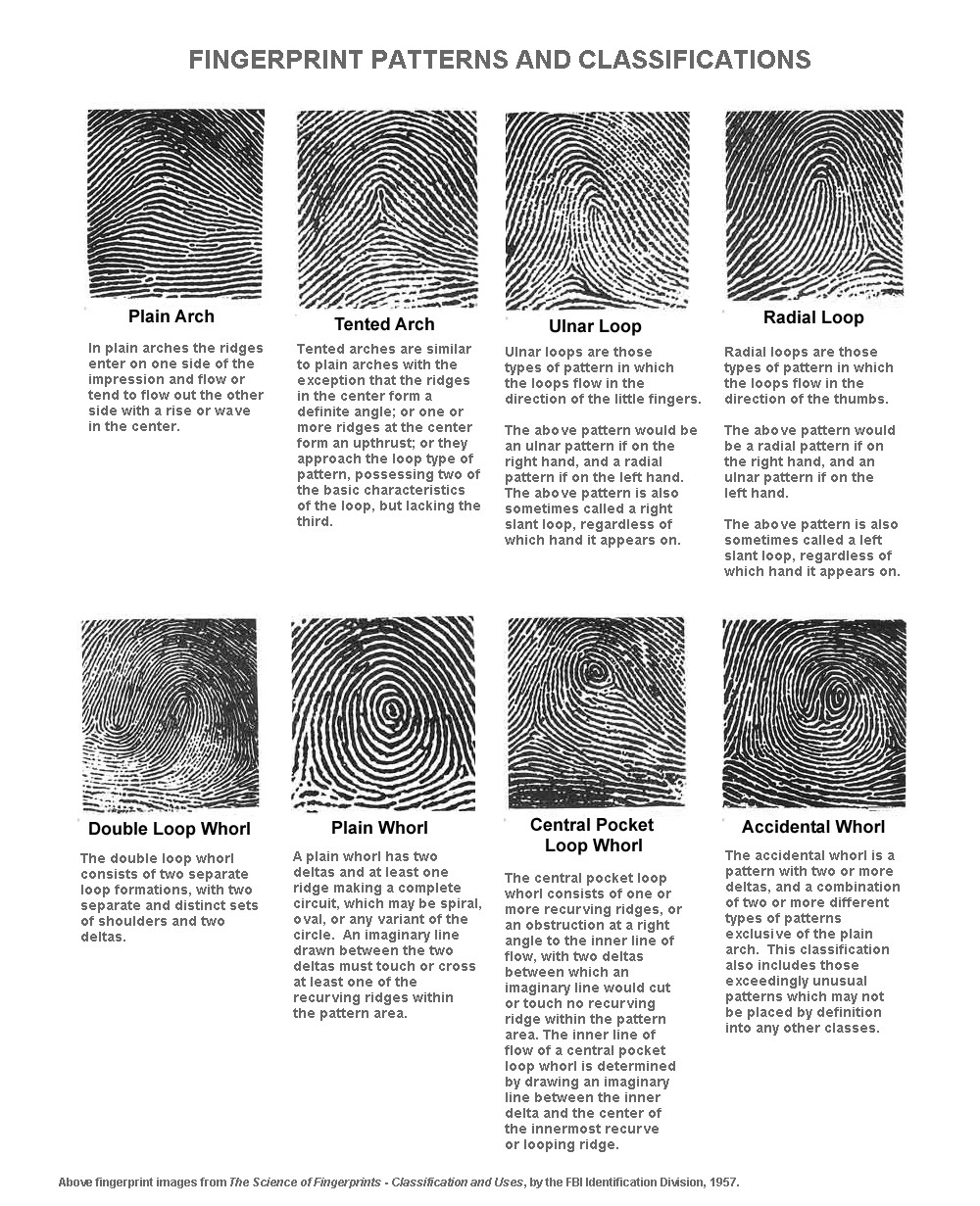
Subscribe to:
Posts (Atom)