Monday, March 31, 2014

Forest sounds process —chance system

After playing around with the sounds for a while, I started to get frustrated because I kept trying to make them harmonize as I might a traditional music piece. But then I remembered the assignment we had to do in class, and the fact that Cage often relied on rules based on 'chance' to create his compositions.

So, I made up a system for how to pick, edit, and composite the sounds on Audacity—and I figured whatever comes out comes out and I'll just have to force myself not to cringe.

Going with a very similar set of rules as the ones we made for the Cage assignment, I used a dice roll app to roll three dice at once, and recorded those results 12 times.

The 12 sound files I'd previously picked out of the sound bank were numbered off from 1 to 6, with two of each number (two ones, two twos, two threes...etc). As were the 6 effects I thought might be more interesting.

The first number cast by the dice would correspond to one of the sound files (and if you roll a 1 twice, for instance, there'd be two 1's to pick from, so it wouldn't be so repetitive). The second is the one that designates the effect that will be used.

Now, here's where it gets a bit more complicated (only not really, it's just a bit of a turned-around process). The addition of the THREE numbers, is the duration of the track being edited. And the THIRD number of the three rolled dice, corresponds to the seconds from the end of the previous track in which the new track will begin playing.

So, if I get the numbers 2, 3, 4 (9) and 1, 5, 6 (12).

  • On the first series, the 2 picks the sound file, the 3 the effect, and the 4 the second when the track starts. The 9 stands for the duration of the track.
  • One the second, the 1 is the sound file again, the 5 the effect, BUT, the 6 corresponds the number of seconds from the END of the FIRST track on which I will make this new track start. Again, the 12 stands for the length of the track
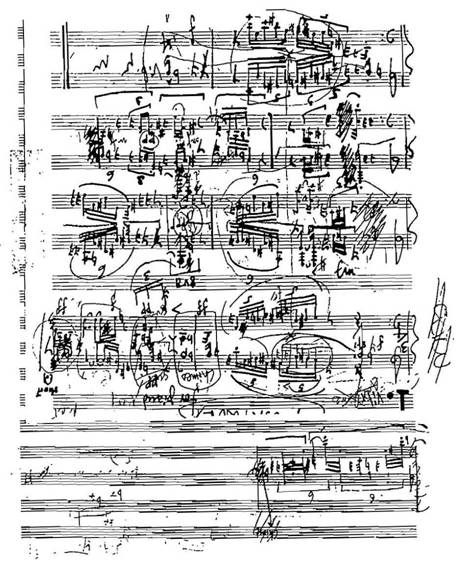
Here's a picture of the numbers I drew, and the effects they go with


Seeing as simply stringing them one after the other would be too boring, and because, in the name of practicality, I know better than to tackle anything too long when making a stop motion video (if I want the sound to be synched up smoothly)—I decided to start at second 0 again, once I got to the 7th draw.

All in all it all lasted around 1 minute, which is a reasonable length to work with, animation wise, I think.

The composition (for lack of a better thing to call it) that came out of this attempt is not particularly melodious. This was to be expected, but I'm still considering appropriating a forest-y enough soundtrack to stick on top of it (just for the sake of my own peace of mind).

But anyway, the audacity file is kind of impossible to screenshot, due to the layering and the fact that I can't make the tracks thinner in order to be able to see them all (or most) without having to scroll around a lot in every direction.

SO.

Here's a screenshot of the whole composition exported as one track.


Sunday, March 30, 2014

Forest sound project Process (5)

This project has been challenging  since I believe we think more visual than sound based in projects. And what makes it more challenging that it has to be site specific where the audience would be able to identify specifically to the Austin Carey Forest. In addition, the struggle I believe I have is making a project that not only will be successful in understand where its from but to have fun. I believe the three of us have at least mastered our intent of the "fun" of the project but connecting it more conceptually. Our project started out with the idea of making instruments (the Austin Carey girls) but has shifted over time where it was a possible interaction for the audience with a bank of sounds that we would collect had have them make there own beat. But there were the issues of concept and how is site specific. But I believe we have now finally been able to accomplish the loose ends with tying in a visual aspect, sound and interactivity from the audience. Today collected a large sound bank of different sounds from trees, flowers, weeds, etc. These sounds were our way of interacting with the forest with some sort of beat. In addition, we took multiple pictures were the sounds would connect with a visual aspect. All the sounds were taken with a contact microphone that we connected to a computer to capture it clearly.

Forest Sound Project Process (4)

So Emilie, Miriam, & I went to the forest Sunday morning to record our various sounds from the forest. We used contact mics connected to my Mac, then recorded using Audacity. It was fairly simple. I knew Katerie was talking about people having problems using the contact mics but it seemed to be smooth sailing for us. We went into the forest, simply connected one contact mic end to my Mac microphone input and the other end to what we wanted to get sound from, whether it was my hand or an actual tree or plant, then proceeded to open Audacity and change the input settings. Then we clicked record for each sound. Here are some sample waveforms of what we got...


Forest Sound Project Process (3)

Images of us playing the forest. We recorded the sounds with a contact mic connected to a laptop using Audacity. 


Since we want a user to play the forest as well, we are making a program where the user presses buttons that play the sounds corresponding to the plants we were playing as well. We have made icons from pictures taken at the forest of those specific plants that will be toggle buttons for the sounds. 


when the icon is not pressed therefore no sound is being played, the icon will be grayed out. as soon as it is clicked, it will turn to full saturation. The temporary names are for organizational purposes within our code. 


Recoding with pro tools/Responses


Soooo I went to the sound booth to record some forest danger info. Basically just me reading off info from websites. 

I'm feeling mixed up on this project. Senior project mixed me up. But i'm moving forward:

1. TEXT vs SOUND and RISK vs HAZARDS: One of the people who em-mailed me back made the important distinction between risk and hazard. Risk is calculated against hazard when people make a choice about something, like going into the forest. So I was thinking about having the scary consequences of the hazards be sound, and the more even tempered responses given to me by forest-expereinced people be text that appears in the virtual Austin Carrey forest that is broken into ZONES:

TICK ZONE:
Dangers of being bitten by ticks, focusing on Lyme Disease. Zone has a lot of tall grass, tall tress that sway slightly. Perhaps even some tiny ticks hiding in grass if you look closely!

SNAKE ZONE
Dangers of snakes, esp. Rattlesnakes. Lots of hiding areas for snakes, like holes, logs.

SUN ZONE
Open sun with no shade. Sun bears down on you mercilessly. 

TREE ZONE
Windy zone with lots of unstable tress; tall and sickly, broken branches hanging down.

So this is borrowing a lot from "game" aesthetics and design to try and create a conceptual experience that makes the viewers wonder about the risk and hazards of the forests, and exactly how scary they really are. If you go through all the zones (in order, as a game) you can reach the "top" of fear: a place to overlook the whole forest, a place WITHOUT SOUND OR TEXT. An impossible view in reality, but, in a game, a nice fantasy we hope to see: understanding. 

Ears Have Walls

Describe the metaphors that the author uses for sound and smell vs light?
Sound and smell fill a space not in a liar fashion as does light. Light moves "from source to destination" while sound and smell don't move in a angular way yet they just spread around a space filling a space. Sound and smells also have the power to relieve and invigorate as do smells. 

How is sound extramural?

It adds another dimension to art that has typically been left to other. Also, it introduces timely events into the permanent world of art. 

How is music in the Western sense architectural?

Time and duration thicken and aggregate into space and place. 

What is the difference in sound and image in cinema according to Chion as paraphrased in the article?

Chion states that the viewer of an image in a cinema can almost always see the edge of the frame however sound in the cinema has no framing there are no confinements to the sound. 

Frame sound as exploratory in a spatial way. Give examples from the article or from art work you have seen as part of the class PowerPoints.


How is sound immersive? Describe two situations: one example from the reading on the immersivenss of sound and one from your own personal experience.

The immersive example given in the text is the MoMA piece, In Volume: Bed of Sound, which the viewer snuggles into a corner of a large bed and puts on a set of headphones. The person becomes immersed into the sound which is music created by the artist. 

What is the relationship between the idea of sound as a habitat and sound as immersive?

For sound to be audible, it is needed that the listener be in us just as much as we are in it. We inhabit sound because it happens to us. Sound becomes inhabitable because it is voluminous. Sound can easily penetrate a space. 

What is kind of agency exists between sound and the apparatus and sound and the object?


What sort of power does sound have over vision?

Sound is a result of pathos. It is an attempt to occupy space, to make oneself herd at the cost of others. The invisible is able to be visualized through sound.

Wednesday, March 26, 2014

Mapping Experience

I have experience using highway and road maps to navigate, I've used gps systems before to track bike routes, and using technology like Google Streetview and Google Earth to "navigate" virtual sightseeing. Never really experimented with it in an artistic sense more than trying to "draw" with my bike as I traveled through the city, following specific routes.

Project 1; More process

Some Sketches:

In Process:
 
 
Photos:


Monday, March 24, 2014

Steven Connor - Ears Have Walls Response

Pertaining to our project, sound is critical in how we view the piece. Our project won't necessarily be in a gallery setting but it is interesting to note that gallery walls do in a way have ears. The way that sound is set up in a gallery can heighten the perception of a piece. It can make us feel a certain way or  lessen our interest for it. I can imagine being in another room and hearing a particular sound that can draw me from that room into the one playing the sound. And vice versa.

Sound permeates all over the place, especially a four-wall enclosed space. In terms of our project, viewer participation is highly encouraged and the immersion of sounds is important to think about. The ambiguity of the potential sounds from the forest can draw others to want to play with them and decipher what they are and where they are coming from. The spatiality of sound is also very vital and the objects that can potentially surround and/or obstruct it.

Intermediacy- using other teams method

https://docs.google.com/file/d/0B1OurKDpk7E4Z0VieThJQkRWcEk/edit

Using the other teams method via a random dice roll app online.

Questions for Ears Have Walls


Discussion Questions for Ears Have Walls

Describe the metaphors that the author uses for sound and smell vs light?

How is sound extramural?

How is music in the Western sense architetectural?

Time and duration thicken and aggregate into space ad place.

What is the difference in sound and image in cinema according to Chion as paraphrased in the article?

Frame sound as exploratory in a spatial way. Give examples from the article or from art work you have seen as part of the class PowerPoints.

How is sound immersive? Describe two situations: one example from the reading on the immersivenss of sound and one from your own personal experience.

What is the relationship between the idea of sound as a habitat and sound as immersive?

What is kind of agency exists between sound and the apparatus and sound and the object?

What sort of power does sound have over vison?

Friday, March 21, 2014

Questions goooo

So I sent this e-mail (altered slightly for different recipients) out to all the people Katerie recommended:

Hello,

I am a student in Katerie Galddy's senior Advanced Practices studio class, and as usual she is having us go out to Austin Carrey Memorial Forest to do a project on the forest. I have visited the forest two times now; it's a really interesting place with a striking balance of human control and wild nature. I asked her if she had anyone I could talk to about my project, and she mentioned you!

The project is centering around the theme of "fear," and the forest as both a trope/stereotype of a frightening place contrasted against the real, serious dangers in even managed forests. How justified can worrying be? When does concern for safety become paranoia? How can even-tempered statistics ever hope to match up to our vibrant imaginations? After all, if it happens to you, it hardly matter that it was one in a million!

This is where you come in. I want an experts opinion of how dangerous forests (specifically, Austin Carrey Forest and forests in Florida) really are. It doesn't need to be anything complex; a few words over e-mail would be great, unless you want to meet up and do an interview. I have explored the forest myself and done research on typical dangers like snakes, ticks, and heat stroke, but the thoughts of an experienced individual who has spent years working and researching in forests will be far richer than my own shallow explorations.

For example, what do you worry about in the back of your mind when you go into the field to do research? Have you had any harrowing experiences or close calls in the forest? Do you think the forest is actually a dangerous place for humans, or are most fears exaggerated or mythical? I know this may seem really basic in many ways, but in a world overloaded with warnings and scary news stories, the way we approach fear as modern humans is really important for our individual mental and overall societal health. As such the "primal" arena of the forest is a great place to start thinking about the phenomenon of fear and worry, even better the managed forest, a place that tries to control the wilds, but not destroy it.

Thank you so much and have a nice weekend,
Katie Green

Let's hope I can come up with something awesome from this, and that these scientists are nice enough to respond to my inquiries!

Wednesday, March 19, 2014

Process 2

Can Audio be as Characteristic as Visuals?

I am now thinknig of creating a processing sketch and if I'm short on time maybe a webpage.
 But what I am thinking is to create a generated layout of the forest and where mouse movement will trigger various sound in a 5 channel sound environment. Some sounds will play through out the entire experience but other will be based on location. The visuals for the forest locations will be based on audio characteristics of forest locations portrayed visually. I do not think I want the audio- visuals to be site specific but possibly be adjusted up, down, forward, or backward like a delay.

All this is based on the Cage readings. Now considering it I will try and make some complex sund to add to the "charcter" of the audio.

Monday, March 17, 2014

Project process

http://prezi.com/d_zqiaa4ai5a/?utm_campaign=share&utm_medium=copy


Project Prezi Link
Sound project

Progress project 2

So I'm going just slightly off course from my original idea, only because going out there numerous times is not as efficient. So I'm still considering recording several "layers"of rings of the area, for example where the first round I make circles and wind in I record the floor sound, the second time its middle area, third time it will be towards the sky region. I was listening to orchestra (and honestly any general bands or music generally) and its comprised by multiple instruments to make a final piece, a systemized way. So my individual instruments are the different layers I record. I also want to see about using Audacity to filter the sounds. I'm still sticking to enhancing or boosting volume or cutting off one of the "layers" of sound during a part of the music ensemble, mimicking how orchestra can concentrate on one sound or have them all playing. I'm still sticking to taking nature and controlling it in this way, but still letting it take its natural course to develop on its own. 

Indeterminacy: theirs

The system:

1. blue = amplify
2. red = changed pitch +
3. yellow = changed pitch -
4. green = fade in
5. orange = fade out
6. purple = add noise

Edit in intervals of 25% of clip, following the order of the colors.

-----

Results:

"roll" 1 - red = pitch +
"roll" 2 -  orange = fade out
"roll" 3 - blue = amplify
"roll" 4 - orange = fade out

https://soundcloud.com/user9634010/theirsound


Indeterminacy: ours

Documentation of dice results
------------------------------------
6 sounds for 1st dice:
1- Sound A
2-Sound B
3-Sound C
4-Sound D
5-Sound E
6-Sound F

6 filters for 2nd dice:
1-Amplify
2-bass boost
3- change pitch
4- compressor
5- echo
6- invert

Lengths for 3rd dice:
1- 1 sec
2- 2 secs
3- 3 secs
4- 4 secs
5- 5 secs
6- 6 secs

https://soundcloud.com/user9634010/bychance

Indeterminary Exercise

Our system:

1. blue = amplify
2. red = changed pitch +
3. yellow = changed pitch -
4. green = fade in
5. orange = fade out
6. purple = add noise

Edit in intervals of 25% of clip, following the order of the colors.


Example wav clip:
Blue ----> Red -----> Yellow ------> Green
 2 sec        2 sec           2 sec               2 sec   =    for 8 second clip

https://www.dropbox.com/s/piypdi9ea3tlt5m/Indeterminary%20Exercise.wav


Forest sound project Process (2)

https://soundcloud.com/miriam-miyara/hitting-weeds

https://soundcloud.com/miriam-miyara/palm-palm

https://soundcloud.com/miriam-miyara/pine-against-tree

https://soundcloud.com/miriam-miyara/pine-cones

https://soundcloud.com/miriam-miyara/tap

https://soundcloud.com/miriam-miyara/bird


Post forest progress — 2nd visit (mid process crit)

Now that I've a whole bunch of sounds that Elexis and I recorded, we have a sound bank of sorts that gives us a lot of choices, even if we're working on completely different projects. It's actually kind of interesting to think about, since we'll be able to see how each of us uses the sounds to their advantage.

This weekend, I wanted to start working on the score, but then I realized the symbols for each sound/instrument should be well thought out before I even think about putting them on a music sheet. So. I've been brainstorming about the categories—mainly about the division between natural and artifical/construction sounds—, and subcategories, and trying to come up with possible 'notes' to use for some of them.

So, essentially the groups would be these:

NATURAL

  • Steps
    • On leaves
    • On mud
  • Bugs
  • Birds
  • Brush/wind plants
CONSTRUCTION
  • Saw
  • Tractor
  • Forklift
  • Measuring tape


Cage Inspiration


Sunday, March 16, 2014

AC visit with Jiri

So I went out to Austin Cary Forest on Thursday with Jiri and had the Sennheiser mic with me, a preamp, my laptop and put it all together and walked around to some dead trees, listened by ear, listen a bit with the mic, and then tried recording some things.

Unfortunately, I wasn't able to get anything conclusive. I've amplified my recordings and there are clicks but it's impossible for me to tell if the clicks are my hand, the bark, or the insects.


However, the other day I mentioned on a post that the Deathwatch beetle has become somewhat of an interest to me. Here is a video of what they sound like http://www.arkive.org/death-watch-beetle/xestobium-rufovillosum/video-09a.html

Plinkies

https://soundcloud.com/user9634010/wireplinkiesample

https://soundcloud.com/user9634010/plinkie1

https://soundcloud.com/user9634010/plinkie2

More weekend progress

A text doc with the content to be read, recorded, and put into the game (copy and paste):
https://drive.google.com/file/d/0B1OurKDpk7E4dlF6NGVmaFFZRHc/edit?usp=sharing

I have a lot of questions and material for the mid-process crit. I kind of want input before I continue; with a few major questions about how the content should be presented. I also need to the sound booth and a few people to use for recording, unless the feedback changes my plans.

Saturday, March 15, 2014

Brainstorming-After forest 2

So... I got the sounds I needed from the forest! 

In talking to Scott, I think... it helped me change the direction of my work. He said the most dangerous thing you can do in the forest is "eat lunch," because half of all death are heart attacks (i've researched this and for the first world heart attacks are the leading cause of death) 

So it made me think... it IS true that the forest is dangerous, and that our reptilian brains fear the shadows for a reason. But it's also true that we overact and stress out over threats that don't exist.

So I think now my project is about FEAR as experienced through the stereotype/cultural trope of the "spooky forest." Because the scariest forest exists not in reality, but in our own minds. When I was a kid I had OCD and developed a compulsion in which I listed any ways I could of for me or my family to die before I went to bed. I did this for fear that if I missed something, it was liable to happen to us, and the list keep getting longer and longer. I'm not going to go into the mysterious mechanics of OCD, but use my own worry-prone mind to make an art work that reveals this obsessive strain of worry in our modern lives that stems from primal chemical defense mechanisms honed in the "forests" of our ancestors. 

As you walk through the "forest," through think PNGs of underbrush and bumping into models of pine tress, unable to see any kind of path but moving forward, you will hear the crunching of footsteps as in any typical first-person game. But, as you move, you will hear the voice of worry (my voice, probably) listing off the many dangers of the forest ripped from top google searches on the subjects (such as what happens when a rattlesnake bits you, the side effects of tick borne lyme disease). When you stop moving, the voice of Scott talking calmly about these very same dangers and their relative rarity will fade in. But if you move, his voice will stop and the strained, concerned voice detailing the terrible "what ifs" will come in. 

So this work is about worry and fear, and the push and pull of fear of rare but awful dangers weighed against the logical, even tempered facts.   

Also here is a screenshot of a the start of a pine tree model for the game. 


Friday, March 14, 2014

Process 1 Sound.

I've been contemplating the idea audio is almost just as characteristic as images are if not equal or more. It my be the fact that visuals are so dominant that we tend to deemphasize audio but  it is most certainly true that subconsciously sound plays a significant role.

Some thoughts I have regarding the forest are the mutant trees (the grafted ones). it is interesting how these trees are two identities in one. One is the stump with the roots and the other is the grafted on top which becomes the majority of the tree that we see. so i was thinking to identify with the two simultaneously growing trees.
in relation to this i was also contemplating editing thesound where you have audio coming from multiple directions. 

like this:
All-in-all I was thinking of making music with the various sounds of the forest, or maybe more specifically from the various trees and have the different trees' sound coming from different locations auditorially. 
I would use a piezo, an ambient mic, and a cardioid mic.

As of now I kind of have three working ideas but the last one is more so my working direction.

Cage, Kaprow and you

Write about a visual experience that recalled an aural or sound experience. Then write about an aural experience that recalled a visual experience. Describe each of the modalities was related to the other for you. Think about the way that Rilke and Kaprow thought about or apprehended vision in terms of sound. What parallels if any are there between your experiences the ideas or methods of Rilke and Kaprow?


Some visuals are inseprably tied to the sounds they reference. For me seeing certain cartoon drawings or images remeind me of the theme songs related to them or even just watching tv without the sound you can still play the audio in sync inside your mind.
Evertime I hear certain types of orchestra music it reminds me of old cartoons like Looney Toons, Tom and Jerry, and the like.
like this: 

I wonder if it is possible to disassociate with preconceptions because as sooon as we experience something then it is stored later and becomes a preconception that we use later. To constantly be in a state of ignorance in that sense to then create poetry will be nonsensical  sense peotry is intrepretive, requiring some level or preconception. As this relates to visuals and sound well I wonder how new sounds can effects us emotionsally and if music was composed from new instruments and semi-novel sound could it strike an emotional chord with us as the type of music we are accustom to.


Google Earth


Chion Listening Excercise


Tuesday, March 11, 2014

Forest Sound Project Process (1)

So thinking more about our sound project, we are leaning towards the ACG (Austin Cary Girls) group band thing and creating instruments from found materials from the forest. Again, we are thinking about the idea of repurposing and recycling; utilizing naturalistic materials from the forest and creating man-made objects that produce sound with them. Thinking past the lines of recording the sound from the forest, we want the recreate sounds that you wouldn't typically here from the forest using things that come from the forest. Make sense? We are thinking of making this project all-inclusive and possibly creating a nice branding to go along with our sound piece. If we are to participate in the forest party and perform, it would be nice to have an all-encompassing logo and brand. Plus, a poster for everyone to come out and see us. But that's in the future. As of now, we need to go to forest and start looking and collecting materials. As for instruments, we each want to create one instrument, one for each person to possibly play. These instruments include the xylophone, maracas, and maybe a drum. We are still pondering about the last instrument. As far as the xylophone goes, we thought about creating using various lengths and thicknesses of the tree bark. The bigger and thicker the piece of bark, most likely the deeper the sound will be. It will be a transgression from big pieces to small, thin pieces. But the first thing we need to do is just head to the forest. We really can't do anything until we go there and get our hands dirty; see what we can get and repurpose. I am semi-excited for this project. I say semi because school and work is kicking my butt and I'm physically and emotionally tired. But I'll get over it.

Monday, March 10, 2014

More Brainstorm

So, thinking about the sublime and the sounds that walking through the forest makes- I really do think a "game" might be appropriate for this project.

1 Go to the forest and record myself walking through the more "unmanaged" areas.
2 Talk to the guys about the dangers of the forest, and record what they say.
3 Render a digital "forest" space through Maya and Unity: make it dense, allow persons to walk through the models so they are engulfed by the environment. Lots of fog, hard to tell where you are going (NOT the slenderman forest...)
4 Add the sounds- when you walk forward, the loud noises of me moving through brush happen. As you walk along, maybe you can hear voices speaking of dangers of the forest.

Sound Project Progress

I've decided to stick with the idea of recording ambient sounds at different heights between the canopy and topsoil of the forest. I've been emailing with Scott and it seems that the best I can do for recording high up in the forest is to use a ladder, and I don't feel like that'll be high enough. I'm thinking I may go to Payne's Prairie and record the high-up sounds from the lookout tower that's there, and then get the sounds which are closer to the ground at the managed forest. Scott mentioned that there was digging going on that I might be able to take video around, for the parts where I'd like the camera to be underground.

Sound project progress

In meeting with Jiri, we talked a bit about different types of beetles, the paths the make, which parts of the tree they live in, and one interesting bit he brought up was there is a beetle that bangs its head against the tree and makes a ticking noise. This beetle is called the Deathwatch Beetle and it's a tiny, hardheaded bugger.

The [superstitious] story behind these guys is that since it resembled ticking like that of a timepiece and it was in the middle of a forest, people believed that the ticking was the countdown of someone's final moments, probably whoever heard the noise.

This back story has roots in things like mythology, folklore, story telling, maybe witchcraft, so I have lots of themes to choose from that can supplement my conceptual reasoning behind wanting to record these bugs, amplify them, and play it back. This countdown idea might be interesting to explore either from an environmental perspective (the fact that these bugs are spreading/the way we are depleting our resources and killing nature in the process) or from a personal perspective that focuses on narrative, nostalgia, catharsis, etc.


Originally, I had wanted to make a sculptural element that would slightly resemble a tree trunk from which my sound would be played back from but now I'm thinking I don't necessarily want it to be site specific and relate to the forest all the time. I'd like this to function in any open space.

Noise vs Sound example (baby crying)

The "song" I mentioned in class that utilizes the sound of a crying baby


Updated Project 1


Includes the original and a new clip of the the larva. You have to watch for it!

Sunday, March 09, 2014

Project Two- Brainstorm

I need to work on my idea as It's not really "sitting" well- aka sleeping on it is just rustling cobwebs instead of providing insight (it works sometimes)

So I want to explore the notion of a "spooky" forest- but get into the origins of why a forest could be so "spooky," and that forests are places of danger for human beings, full of darkness, predators, and death even as they provide light, food, and life on the other token. So basically- yes, movies and media about danger in the woods are cheesy, but at one time humans lived in fear of the deep dark woods. Primal fear is real fear.

OVERUSED TROPES/CLICHES TO EXPRESS DISTRESS IN THE WILDERNESS (primarily narrative strategies):
-Heavy/panicked breathing
-Shaky cam- "Blair witch"
-Camera on feet as person runs
-"HELLO? IS ANYONE-" *murdered*
-String instruments
-Deep base
-Glowing eyes
-Strange noise in distance
-Camera getting dropped and showing person running/immanent danger
-Wolf howls/owl scream/woman screaming
-Troll scares, jump scares, crying wolf, keeping 'em guessing- bush rustles; it's a harmless animal, but the next time a bush rustles it's a hungry predator/crazed lunatic
-Panicked monologging
-Effects changes- black and white, excessive motion blur, etc
-POV switch- victim to eyes of predator, and back again

The primary question I am asking myself here is do I want to PARDOY and SUBVERT these tropes in some meaningful way, assuming a certain level of media knowledge in the audience, or try to avoid them at all costs and create suspense in my own way? I do not want to tell a story, simply set a mood.

-Can I take the natural sounds of the forest and distort them to be unsettling, providing an unorthodox soundtrack to orthodox footage of the woods?
-I think I want this short video to loop forever- nightmarish, never ending. Trapped by fear.
-Presentation- is a regular projection enough? Could I create some kind of enclosed/enveloping environment with my video and "soundscape?"

Ok that's all I got... I wish I had more a "vision" for this... I am very much a person who likes working towards a larger goal that can be "seen," even if vaguely... this time it looks like I'm going to be making it up as I go along, and experimenting a lot. Not bad to try other methods when the usual ones fail, right?

Sunday, March 02, 2014

Sound Exercise

BY MYSELF

FIRST SOUND:

The hum of my laptop's loud fan. It's really loud because it is very old. It's coming from underneath my laptop, on top of my legs, and although i can't pinpoint the exact location of the fan, it seems to emanate from underneath my keyboard if i don't think about the source. It fluctuates a bit, a tad ragged, but steady. Like a constant exhale. It is punctuated by slight clicks and chirps from the hardrive, which isn't working particularly hard right now as I don't have open other than a browser and skype. 

I know the source is the fan, but I think it's muffled by dust, the plastic casing of the laptop, and all the other metal and plastic parts inside the computer. I must reverberate about these, being absorbed and transmitted by the all the objects around it, until it reaches my ears... like light. I also have bad earwax in my ears right now, so it's not as loud as it could be, this i know (little tmi for ya). I also know the other mechanical noises made  by moving parts (ie the hardrive) add to the sound of the whirring fan. I DON'T know exactly how the fan makes the sound... I don't know the shape of the fan, or really what direction it moves in. I'm not even sure where the fan is located, exactly. 


SECOND SOUND:

The "vrrom" of boats on the lake in the distance. I'm in my room, on the backyard side in my moms house, and it faces the lake. It's a sunday so people are out boating. It's pretty steady, but comes and goes as the boats zoom past my side of the lake. I can hear the heavy swishing as the bottom of the boats slap the wakes, the changing in the volume of the motor as the boats slow down and speed up, going into turns and straightaways. It's not particularly violent or exciting; for me it is calming because this steady drone is a familiar memory in my childhood. It reminds me of sitting on my bed and drawing or reading, of sitting on the porch with my dad and relaxing. I like the sound.

I DON'T know the exact parameters of the boats or people involved. I don't know exactly where the sound is coming from. My ability to predict the sound's intensity and location is very general because i can't see the source. The sound is muffled by the house, the walls, my ears, the distance. It requires active focus to be really aware of it most of the time, a sort of white noise. 

THIRD SOUND

The sound of the TV from the living room. Everyone knows what TV background noise is like. It's there, but you don't have to pay it it any attention. If I listen actively, I can identify the content of the show/movie/ad, but that only happens if i AM paying attention. It changes constantly, the sounds changing to match the visual content on the TV... voices, music, sound effects... a jumble of sounds from reality that have been converted into digital signals and back into reality.

I know the sound is generated by the vibrating of the speakers and into the air... i know the speakers on the big HDTV are blown, as it is an aging television... I can therefore make a qualitative judgement about the quality of the sound: not that good. But since it can be white noise for me now, I don't need to care. 


SEMANTIC LISTENING

Mom, sister and friend having conversation in the other room. I can certainly understand the context of their conversations. They are mostly complaining. I can differentiate the familiar voices that I have heard for years. now, they moved to the other room... i can still make out human voices, and who is speaking, but not the words so much... but i know they ARE words.I can make out the emotions in them, too. I can tell if something is wrong or not... and of course nothing is wrong. I react to volume... my sister yelled to her chicken and I noticed it. The softer talking I don't notice as much.

Now i hear Ruby's high pitched clucking. I know what that is. It's not words, but it has meaning. She is reacting to the humans around her. My sister is complaining about "generic attractive women" on TV. I can easily make out these sentences. But If i don't focus, and go back to reading a manga whatever highly intellectual pursuit I was just engaged in while I was breaking from this exercise, the voices and their frankly inane conversations fade away into the background as noise. 


REDUCED LISTENING

I'm going to focus on this laptop fan. It's here and it won't stop. 

Describe the sorts of pitches (high or low) characterize this sound?
Low, and constant. Like one line of sound.

Describe the volume of the sound?
Soft. So soft it's easy to ignore and fades if louder sounds come into contact with it

Describe the kind of space the sound creates?
A small, gentle space. It is lulling and kind of soothing. It can put you to sleep.

Are you able to feel this sound? What parts of your body does this sound impact and how?
It is a whisper. I feel it on my legs and in my chest because of the proximity- the laptop vibrates slightly. The sound is passive and my body does not react to it much.

What sorts of silence if any are found in this sound?

It BECOMES silent if it is drown out by louder sounds. It also creates a bit of white noise, enough to create a thin blanket between me and the rest of the world. 

How many different sounds comprise this sound and describe those sounds?
About two sounds... the whirring, and slight clicking.

What is the texture of this sound?
Sort, but with small dips and grooves in it. Like a worn blanket.