Thursday, March 31, 2011
Kelsey and her pre-process work
Renate- Food Project challenges, sucesses and final thoughts
From my last post I had a lot of things planned out in my head, I just needed to make them a reality which was more difficult than it sounded.
Finding a table
I contemplated making a table, finding a board to put on top of two pedestals to make a table, and asking everyone I knew if they had a table I could borrow. I wound up finding a table from Art Ed, the challenge was carrying it to and from Norman. I wound up getting help at the last minute. A big thank you to Greg!
The Cookies
I've actually never made these cookies on my own before so I had to get the actual written recipe from my mom. I originally wanted my grandma's but I was reminded that hers breaks cookie presses, so I got my mom's version. I had to run some test batches to make sure that they came out correctly. The most important thing I learned from this is that the best and easiest dough to work with is made with a room temperature egg and VERY softened butter, (left out of the fridge for two hours. So my house is filled with cookies of various levels of delicious right now.
The Cookie Press
The one was a biggie. My first major problem was that I didn't have one! It never occurred to me because I usually make cookies with my mom back home and we use hers. I started to investigate alternate ways of getting the same traditional wreath shape pf the spritz cookies that I wanted and learned that it was possible with a piping bag and a star shaped tip. My mom warned me that it wouldn't work, and in the mean time I managed to borrow one, Thank you Katerie!
The cookie press, however, probably caused me the most distress out of everything! My first mistake was not testing it out until the night before. Since there were no instructions and I hadn't this particular kind before, It took me some time to try and figure it out.
My cookie press that I left at home
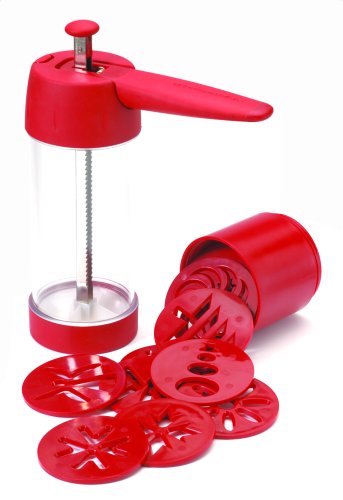
Katerie's "Dial-a-cookie" style press
Looking at the press, I thought I had no problem trying to figure out how to put it together. I perfected my cookie dough and I was ready to go... As soon as I started to crank the cookie dough out it was a disaster! The plate wasn't attached tight enough and the dough started coming out of all the cracks. I fiddled with it for hours trying to figure out what I was doing wrong or how to attach it properly. I thought that maybe I was missing a piece that would make it fit properly. I tried using foil or plastic wrap to help bridge the gap, and no luck. No matter what I did, the dough kept coming out all over the place. It was so frustrating at the time that I didn't think to take a photo, but I did draw this illustration after the fact,
I was also upset because I was very intent on making my cookies to mirror my grandma's in the video which were the traditional wreath shape. In order to do this I really needed the press, but I did try other ways, I went out and bought a variety of pastry bags and different tips.
I managed to get one batch made this way, but on the next batch I broke about 5 pastry bags and wound up making them in a round shape instead.
I spent a good couple of hours trying to figure out this whole thing, I also realized there was no way that I could give a full demonstration of the cookie making process. There were too many things I would have to bring up and set up, I take the bus so there's only so much I could carry.I also needed to use the mixer, which is loud and big and takes time. I decided I would bring my dough pre-made
and show the action of putting them onto the pan. I still really wished I could get the cookie press working. I decided to do a quick google search and see what I could find. After searching dozens of forums I found a picture of a properly assembled version and was astonished that the whole time I had simply attached a piece upside down. I sure felt silly.
This is how I thought the plate attached:
This is how it's supposed to attach, problem solved:
Now that I had the cookie press plate on properly, it worked perfect.
The Projection
This was the other big problem that I encountered, mostly because since I projecting onto myself, I couldn't see the projection very well. I tried to set it up at home, and that was difficult because I didn't have the table with me. It was too heavy to Carry home. I caught the very first bus that left that morning which brought me to school around 6:30 am, and I stayed there until class started. I fiddled with the projector, my apron, myself, and various tables, propping the projector on an angle, duck taping it, and so forth. Still I couldn't get my image just right. Right before class started, I did manage to get help because people started showing up. Sara was the first to show up and helped me, and then Mike helped frame the projection to my apron with some paper and tape.
The Monologue
I went back and forth about what I was going to speak about. At first I was going to talk about the recipe as if it were a cooking show. I decided against this kind of last minute because of two reasons. The first being that I couldn't pull it off technically, by transporting all ingredients (especially some that need to be refrigerated) and the mixer, measuring cups, bowls, and so forth. I just couldn't physically carry it all. The other reason was because as I watched the home movies I realized that the importance of this was not in sharing the actual recipe with it's physical ingredients, but the memories associated with making these cookies. This is what I wanted to focus on, so I wrote my monologue based upon that concept. Since I didn't leave myself enough time to really get it down, my performance could have been a lot better.
Those were the challenges, here's what I thought was successful:
I had known from the beginning exactly which home movie I wanted to use, and I had seen it probably a hundred times. However, I hadn't seen it in a while and seeing it this time around was very special for me because I noticed that my mom is the same age as I am now, and my grandma is the same ages as my mom is now. It put a lot of things in perspective for me as far as generations go, and what it means to pass down recipes. I was really happy that the video included my mom dancing around in her quirky fur coat. I just thought it was really perfect, along with my Grandma showing off her oven mitts and dancing around.
I was really pleased that the class reacted well to the video and seemed to really appreciate it, and what it meant to me. I liked that they were able to point out our resemblances. It made me feel very happy to connect this project to my family, and it made me happier that the class got it. I immediately called both my mom and my grandma when I was finished in class, and they both were very happy about it and actually said the same thing, that even though this project was personal to me, they could probably connect to it as well because it would make them think of the connections they might have with their own families.
The cookie recipe seemed to go over well with everyone as well. There were no leftovers, so I'm glad everyone thought they were tasty!
I definitely agree that if I could fix details like the projection and the monologue that it could be a really incredible piece, so that's something that I will definitely come back to. I'd really like to film it as well so that my mom and my grandma could see it. I was glad, thought that Greg took pictures, so hopefully I can show them that. I think it's a really powerful image to see themselves projection onto me, and it's a very special feeling to me to know that they live on through me, and that one day I will live on through my children.
For all the chaos that I endured, I'm really glad with what came out of it.
Wednesday, March 30, 2011
Adam - Farmers Market Trip
Tuesday, March 29, 2011
Project 2: Tea Drinking Experiment Journal
At 1 pm, March, 29th, 2011, me and my friend Feiqi were sitting at a table outside Reitz Union, serving people free chrysthemum tea. The tea is made of dried chrysanthemum flowers and brewed by steeping and piping hot water. After five hours cooling process in room temperature, it was served in small cups. This is a traditional way of making chrysthemum tea since 15th century BC, when it was first cultivated in China.
In Asian culture, people usually drink chrysthemum tea during or after dinner, especially a heavy one, as the tea is known for bringing down body temperatures and refreshing the brain. They drink it slowly and get themselves fully relaxed in the refreshing smell. In other words, the tea is a sign of a slow life and a peaceful mindset. This is very different from American fast consuming culture; Americans tend to have fast eating habits and life style. So I decided to hold an experimental tea-drinking event. That is serving the traditional Chinese tea at the busiest time and the busiest place on University of Florida Campus. A hidden camera was set to record the reaction of people walking by.
We didn’t make complicated decoration. Nor did we actively stop people. That would feel like advertising. We were just sitting there, drinking tea, and waiting for people come to us. If someone comes, we give him/her a simple one-page introduction. We didn’t talk much to each other either. The whole process is about fewer words, but more thinking.
It last about two hours. Many people walked by, including students, teachers, and people who are not very easy to tell. Everyone has a specific purpose. Many people walking with Starbucks in hand; some people got Papa Jones; for someone it was cellphone. There were also people walking in pairs or in groups. Usually they were talking a bit loudly and laughing.
Most people just quickly walked through. A few noticed us but didn’t slow down. Someone slowed down to ask where the music school is. Those who got a cup of tea are people I know. After a warm greeting and a chat about all kinds of detailed things, they said, “oh I already drunk too much soda”.
It was a very unique experience for both of us. Holding such an event is like a “formal” way to sit there and do nothing. Doing nothing is more considered as a waste of time rather than wisdom in modern times. Therefore most people nowadays need a “name” for their mediation activity, although they know they would benefit much from it even just in the name of themselves. This event became the reason for us to stay in our small world. Accordingly, it also gave us a chance to see other people as a group in an objective perspective. When I was watching many overweight people holding take away pizzas or seemingly busy people with cell phones, I began to think what we really get from this modern society.
Like scientists taking notes while doing experiment, I collected the poster, introduction, pictures, and videos I made as well as my personal thoughts. I think such experiment could benefit more people. So I’m trying to make it duplicable.
Adam - Project 2 Fun Facts
I decided to do some research on the myth about using human skin to bind books. Turns out it really did happen on a semi-frequent basis up to 200 years ago.
One example in particular really reminded me of my project.
"John Horwood was hanged for murder in Bristol, England in 1821. Horwood's skeleton became a prized exhibit at the Bristol Royal Infirmary. A book containing details of his crime, trial, execution, and dissection was published and retained at the Infirmary. The book was bound with Horwood's skin."
This excerpt was taken from an article found at this link.
I thought that it pertained to my project specifically because it is a book discussing an individual and is physically made up of their body. It is a very disturbing idea but also really fascinating. A book about a person made of the person. Come on... you can't write this stuff.
Problems
Monday, March 28, 2011
Project 2 landing point?
So at this point I was fed up. I was so burnt out on ideas, and time has basically all but run out. I remembered back to talking about Auntie Annie pretzels, and just thinking about them made me want to get one. So I did. I can't tell you how thrilled I was about it, and I usually never get excited. So I decided to make a conscious effort to think about why exactly I like these things so much. Was it that they're such a rarity because they require one to go to the mall to get? Was it something about their connection to Quakerbridge Mall, near where I grew up in New Jersey? Is it some fabled pretzel memory in my head? I thought of all these things up until I bought the thing, and when I took a bite, I got my answer. They just taste good. Perhaps I just see things in simple terms, but as I believe food is fuel, then the highest acclaim I can give to a food is to compliment its taste. I love them for their delicious, butter-drenched taste, and really, how less valid or meaningful is that than someone with a rich vivid memory of meal time's past on their love of creamed corn? I decided to reel my mind back to the simple, and the silly, and just deal with the wonderful yet ephemeral feeling I experience while eating the pretzel. I think I finally have an idea. It's silly, it's fleeting, it's not incredibly deep, but it's personal to me and my experience. Hopefully you can enjoy it. Hopefully.
Warning: Fatty Substances.
According to the book, yellows and other warm colors are recommended for food packaging since they resemble rich, flavorful foods like meats and cheeses. In particular, yellow with orange bias is good for this. It stated several times that harsh yellows with green bias are a poor choice for food packaging since they seem to indicate nausea or illness. I thought that sort of connotation might be even more useful with the pattern I chose, so I came up with a revised design:

There are a lot of other things mentioned, such as how a red triangle means poison in Czechoslovakia. I'm still working on figuring out what sort of text/imagery needs to go on there, but a red triangle would be pretty alarming, so it's a step in the right direction I think.
White is mostly used as a universal neutral. Chik-fil-A's packaging kind of recedes into the background in that sense, it's mostly white with minimal red forms. Strangely, their large fryboxes have reversed color schemes which renders them somewhat alarming. Red is described as being the pinnacle of attention grabbing colors.
In the beginning...
Sunday, March 27, 2011
Adam - Project 2... laser cut
Here are some poor quality photobooth pictures of them:


Conceptually:
I'm really interested in idea of humans personifying and objectifying the pig. On one hand we make them into lovable characters in a children's story and on the other hand they raise them just to slaughter them for their meat. I think that this book speaks to that strange dialogue nicely.
Project 2
I'm thinking of how I can laser cut certain materials to wrap over these containers. Just as an example the first thing that came to mind was re-skinning them with a diagonal black and yellow striped pattern. I think if the meal was actually served looking like that, most people couldn't help but wonder why the food was placed in such an alarming package. Still working on how I can incorporate why the food is dangerous into the design though. Maybe the Nutrition Facts could be visible somewhere on the packaging as well.
Adam - Project 2, Project 2, Project 2
I decided to construct it out of slices of ham. Laser etched on the book will be the story of the three little pigs. This is a disturbing iteration of a children's classic story displayed on the meat made from the very animal the tale is about.
I will bind the pages with twine, a material typically used to tie up the meat with.
So far I have dried out all of the slices of ham and I am about to go and laser etch onto them. If the laser cutter doesn't deliver my desired effect... well I might just cry.
I'll keep you posted!
Love,
Adam
Adam - Project 2...
Thursday, March 24, 2011
Adam - Project 2 Idea For Real This Time
I am in the process of researching the foods that the animals that we eat on a daily basis are fed. Knowing that the diet of an animal affects the way it tastes, I am interested in creating a video piece that depicts a meal being dissected as if it were being eaten. As the meat is cut away at, it will bleed out the food that went into creating its flavor.
I will achieve this effect through a combination of live video trickery and After Effects editing.
Many more posts to come this weekend!
Wednesday, March 23, 2011
Super-Size Me Experiment
Narayan: Project II Process
Renate's Food Project Update
Working off of my memory of my grandma baking cookies, I wanted to find some way of incorporating what that image means to me.I think what I'm drawn to the most about it is the idea that food connects my family.Something such as the act of making cookies is something that my my mom learned from my grandma and I learned from both of them. I want to embody the idea that my grandma is with me when I carry out the act of baking her cookie recipe and the things my grandma does live on through me. (NOTE: The way I'm talking about this might make it seem as if my grandma is no longer living. She is in fact alive and kickin')
Here's the plan, I'm going to make a dual video/performance piece. I will stand at a table and talk demonstrate how to bake my grandma's cookies, giving you insight as the the history and importance of this recipe in my family. I will use cooking show "techniques" to help with the process, for example having already baked cookies and so on... while I'm doing this there will be video of my grandma baking cookies projected onto my white apron.
Right now my goals are, to fine tune my video and practice. I'm not overly worried, as a teacher demonstrating a task is something I can do in my sleep, I also really enjoy sharing personal parts of my life with others, so i'm really excited to pull this project off. I'm also excited because of how my grandma will react to this project. This is especially meaningful because the last video project that she saw was about me being buried alive and it upset her to the point that she cried. I think that her seeing this video will mean a lot to her. It means a lot to me too. I really like making projects that are personal.
I
Project 2 update again?
Renate's Jello Project Mishap
Frozen Cosby
Melted Cosby
Tuesday, March 22, 2011
Project 2 Update
Project 2 Project 2 Project 2
Monday, March 21, 2011
Food In Progress
Friday, March 18, 2011
Adam - Project 2 New Idea
This project seems like the logical progression from my last project about the brain and functions that it carries out.
Wednesday, March 16, 2011
Project 2 Ideation
I was also thinking more of the food pyramid and how we're told to eat in this country. We try to set guidelines on what our bodies will most respond to and how to properly eat, but each body is different and it's up to us to find what dietary routine works best for us. I remember reading a story a long ways back about an old man living in New York city, I think in his 90s, perhaps even in his 100s. He was in excellent shape, was infrequently ill, and incredibly agile and healthy for his age. So everyone was on him about what he was eating. He replied that all that he ate was bread fried in fatback and two jugs of wine a week. Now if that's not living on rocket fuel, I don't know what is. That's amazing. Can you imagine if a doctor talked to him about eating fruits and vegetables? The guy would have been dead in a week. There's something interesting about this bizarre diets that work, thus making them not so bizarre. It's like this insane balancing board of health, sometimes the things fall into place.
So once more: lots of ideas and concepts, but nothing formal yet. I'll keep thinking, I suppose.
Kelsey and her process


PROCESS
Narayan:Project 2 Update
Project 2
Project 2 Update
In my last post about project 2 I talked about my ideation for the project and how it was leading me in a direction focusing on bacteria. What I find interesting is that bacteria in food can affect us very poorly and even lead to death yet the bacteria are simply fighting to survive. With as much respect as we have to give to animals and plant life that we eat, it is important to give the due respect to the power of bacteria. Thus, with images like the one above of salmonella, I would like to paint, draw, or digitally illustrate them in a beautiful way that would strike the viewer immediately as abstract art. However, either through the title or other descriptive text, I would indicate that they are indeed harmful and/or deadly bacteria. I'm still flushing out the details but I am pretty sure about bacteria as a topic.Project 2 Update
Project Update
Ursitti Response
It is the exploration and appreciation of all things non visual. For example: experiences, smells, and sounds.
What according to Ursitti is the relationship between scent and the gallery or museum?
Ursitti views a gallery as a very prestigious place where it should smell very clean and pleasing. Citing the onion smell, Ursitti further emphasizes the importance of smell in a gallery setting.
What sort of contradiction would an artist who deliberately does not document his work have to live with?
They have to be subject to criticism and lack of a following being that people finding out about him/her would have to experience the work only when it was showing. Also, they do not have a way to look back on their work and use it as motivation to do better and/or improve upon earlier work.
How does the museum sanitize aesthetic experience?
The museum is a clean and in a sense cold place where there is little design or embellishing of the interior. White is often chosen for the walls and displays as white is often associated with cleanliness. The air is crisp and cool and the room is silent which is another example of the common perception of cleanliness and order.
What are some examples of how aesthetics carry political and social values?
The Nazi's symbol, the swastika, is a prime example of how aesthetics can carry political and social values. For that matter, the propaganda of the Nazi's carried with it strong values and political opinions. Furthermore, it is interesting to note that the swastika was appropriated from the Buddhism symbol representing peace and love. This is a prime example of how not only can aesthetics carry political and social values but that they can change over time.
Comment upon Paul Virilio's statement that we are losing the ability to engage with the aesthetic because of the technology and this in turn has made us lose the ability to engage full stop with what we are looking at in front of us in the real world.
This is an interesting and currently appropriate statement in that so many things are seen from afar and not actually in the flesh. However, I would say that many people still desire to see art and aesthetics in the flesh. I do not agree that technology is disabling the appreciation of true art as technology also provides the ability to easily communicate imagery to one another and gain knowledge of aesthetics which may not have been seen without technology.
How did Clara Ursitti integrate the scientific information she learned into her art practice?
She discovered that we never use only one sense at a time and that each experience is interpreted based on the reactions of multiple sensory organs. Thus, art should be seen in more than just the visual realm if it is to be something other than simply a visual piece.
The other day we discussed whether smell was more felt or less mediated than vision. Maybe what where we should have directed the conversation was to the role of language as a mediation for vision vs language as a mediation for smell. Comment upon this.
It is often difficult to give verbal descriptions of smell without comparing the smell to other more recognizable scents. Often we use visual words to describe smells and even tastes. With vision, one can more easily describe something using simple adjectives and other visual references.
Tuesday, March 15, 2011
deCertau Response
The "text" in a book invokes a response in the reader. This can be interpreted in many different ways depending on one's background and knowledge. This "text" is the businesses, the stores, the backyards, and all other places of life. Thus, deCertau is stating that those who live in a city or town respond and interact with the "text" of the place that they live in than a visitor or commuter passing through. A visitor to a certain town or landscape will visit the hot spots of the city, they will notice the big, popular, and more obvious subjects. However, the local people interact with the coffee shops, the family owned businesses, and the secluded areas of town not explored by the tourist. So, the local person reads the text in a deeper context while the visitor is looking for the key, obvious places and things.
There is the city and the concept of the city. Please define each and describe their relationship to each other.
Relating to the previous question, the city is the geographical and geometrical existence of the area. It is the factual information that anyone can understand and interpret. The concept of a city is the heart, soul, and life of the city including its businesses, people, culture, and every other aspect that is less cut and dry. The concept of a city is how it is interpreted individually by the people living and visiting in it. It is the pathos of the geographic area.
Why does deCerteau claim that the concept city is dying? Make sure you have a clear ideas what is meant by concept city before you try and answer this question.
DeCertau is referring to the push towards "the city" rather than "the concept of a city." Thus, cities are becoming less personal and unique and more commercial and cold. More land is taken up, small businesses are crumbling, and poor areas being thrown into projects instead helping the neighborhoods get better. There is more and more care about money and "efficiency" rather than the heart and soul of the people and how they interact with their home town.
How can focusing on the negative privilege a discourse?
Focusing on the negative allows a person, group of people, and city to change and in turn promote progress. If the struggles of a city are constantly overshadowed by "progress" it is difficult to find specific issues that may still remain. It is the same for a person who may focus on one good grade they received while ignoring the others that may not have been so good.
How does deCertau relate the decisions we make when walking to speech acts? You may first have to understand what consitutes a speech act. See bottom of p97.
DeCertau explains that walking decisions are like speech acts in that they are interpreted choices made from a larger database. When one speaks they utilize their language in their own way with their own rhythm and word usage. When one walks a city they are choosing to go places that fit their lifestyle, place of work, and personality. Thus, how one articulates words is like how they articulate the "text" of the city in which they inhabit.
How does deCerteau define myth in the context of this chapter?
A myth within the context of a city deals with the pathos of the city. A myth is a tale that does not necessarily have strong factual basis but is personal to one group. Also, myths are altered as they are told and one's interpretation of a story is likely to be embellished in different areas. While this may bring about inaccuracies, it serves to display the life and culture of a demographic and the city.
Understand the notion of "local authority." Examples of local authority?
Local authority is very prominent. The legal age of drinking is strongly influenced in the area. Also with things such as bike laws, the local authority is commonly seen. Finally, the limitation of no tobacco on campus is another example of authority besides police authority.
What purpose/s could be served by eradicating stories and legends that inhabit places? What are the consequences of this? How is this related to walking?
This would omit the history of pathos within a community. To not have historical references, fact or not, robs a city of its emotion and personality. Stories passed down are what give life to a city. This relates to walking in that one would walk to places simply based on their current status and disregard what they once were. For instance, a person may pass a family owned restaurant with great food for a chain restaurant with poorer food quality simply because they were not aware of the history of the family owned restaurant.
Think of place that you where you have spent a lot of time. “Walk” that place. Pretend that you are describing the landscape to a person you know quite well. As you “walk” and talk differentiate between the parts of the conversation that describe what is currently there now and the parts of the conversation that detail what is not longer present.
"That nice brown brick walled building there next to American Apparel used to be a place called Rue Bar that saw a few renovations but little success and is now being replaced by a new bar with a very different vibe."
In your own words, what does the practice of space mean?
We all see space differently but all form our metal images of an area through our interactions with the area including the people and events that have occurred there.
Taste Tests
The colder apple juice tasted sweeter to me than the warm apple juice but I know that this was against the rest of the classes opinions. I think that maybe it was psychological being that I don't like apple juice and I mostly like my drinks cold.
Salt
1. Quite Salty
2. Not nearly as salty, tasted like warm water
3. A pleasing mixture and thus not too salty.
4. Very very little saltiness to the water.
5. Simply hot water.
Unami
I had never know what msg actually tasted like or why it was so feared. It tastes very odd but the main flavor is meatiness and saltiness.
Sweet & Sour
1. Sugar + Water
Sweet in a very nice and flavorful way.
2. Sugar + Lemon
A great flavor quite reminiscent of lemonade.
Bittersweet
1. Lindt Light
Alcohol flavor, bitter, and not very sweet. The sea salt was very interesting and tasty.
2. Lindt Mid
A creamier and less bitter chocolate.
3. Lindt Dark
No sweetness tasted, very bitter, and almost a burnt taste to it.
4. Lindt Little
The sweetest by far with more creaminess that the Lindt Mid.
5. Baker's Chocolate
No sweetness at all and very bitter.
6. Light Ghiradelli
A different flavor, sharp, and almost cherry tasting.
7. Dark Ghiradelli
Very bitter and bland.
Salty & Sour
1. Mashed Avocado
Very little bitterness
2. Avocado Chunk
Stronger bitter flavor
3. Avocado + Lemon
The lemon strongly overpowered the avocado flavor.
4. Avocado + Lemon + Salt
Tasted quite like vomit. A very strong and undesirable flavor.
5. Avocado + Salt
The avocado flavor was more pronounced and tasted more flavorful.
Sweet & Salty
1. Popcorn + Salt
A nice taste that makes the popcorn a lot more flavorful.
2. Popcorn + Sugar
An interesting but quite delicious flavor.
3. Popcorn + Salt + Sugar
Very delicious. It is pleasing in that both the sugar and salt are present but each flavor including the popcorn is evident and welcomed.
Texture & Flavor
1. Minced Carrots
Very sweet and less bitter than the rest.
2. Chopped Carrots
More bitter but still a sweet flavor was present.
3. Shredded Carrots
The least bitter but the texture was odd and not as enjoyable.
4. Carrot Chunk
The most bitter of the four with more focus on texture than flavor.
Fat & Mouthfeel
1. Fairly long lasting creaminess and flavor with an evident thickness.
2. Lighter texture with a lot of creaminess.
3. Even creamier and thicker than the first two.
4. The creamiest and thickest of them all but it had a nice consistency.
Balancing Fat & Acid
1. Oil
The oil brought about a nice flavor with the crunchiness of the lettuce and the thickness of the oil.
2. Oil + (2 parts) Lemon Juice
The lemon overpowered the oil and tasted too strong so that it was like eating paper with lemon juice on it.
3. Oil + Lemon Juice
Much more tolerable and tasty with a nice contrast of sour and smooth.
4. (2 parts) Oil + Lemon Juice
The lemon had a strong taste at first but once swallowed, the oil flavor remained as a nice finish to the bite.
Map Library Experience
The topics of the book ranged from specific to broad issues. There were maps concerning suburban fire insurance usage to books like the National Geographic Atlas which was dense and covered all different types of mapping. I was intrigued by the peculiar maps such as the Historical Atlas of Christianity, the crime mapping book, and the map of communism.
On display, they had an array of treasure maps including some dated as far back as 1779. The more conventional maps were also interesting. I was intrigued by the Department of Defense's maps, charts, and relevant information.
Finally, there were one-perspective maps of St. Augustine from 1763 including engravings. It was through looking at these that I learned St. Augustine was originally the capital. I realize I probably should have known this being that I did know it was the oldest city! All in all, the map library felt like a hidden gem on UF's campus and I'd like to revisit it again.
Monday, March 14, 2011
Project 2 Idea

My idea is to hold a tea ceremony on campus as performance art. In the US people prefer ice tea and tea bags which coincide with fast food culture, while in eastern countries drinking tea is always considered as a mind training event associated with Zen and Taoism. Thus, in eastern culture there are complicated instructions and procedures of making and drinking tea. It usually takes hours. The whole process is very beautiful and enjoyable. It's actually a sort of art. I want to hold a small tea drinking event with special design of tea set, instruction brochure, music, and video if necessary. All the materials and remains could be indications of what happened.
Sunday, March 13, 2011
Trip to Farmers' Market
Renate and Jing-Taste Experiment

We found the taste experiment very interesting as it put us into an extreme environment in which we had to experience every single little change and be really sensitive to them. We are not scientists; moreover, art makers are usually considered relatively subjective. However in this experiment we were trying to record everything we got "seriously".Wednesday, March 09, 2011
Adam - Project 2 Update
I'm designing a book with several recipes for meals and desserts. On the left pages I have a list of the ingredients with a space to make notes on your observations of the appearance, smell, taste and texture of each. On the right pages of the spreads you have the instructions for preparing the dishes and a larger space to jot down your impressions of the the combination of ingredients and to see if your original observations are still detectable.
I liked this idea instead of doing a public website because I think that the senses you experience when interacting with food are very personal and specific to you. I like the idea of a mixture between cookbook and personal journal that you can carry around with you and add to. Or something that you'd be able to come back to the next time you want to make that dish and see if you still have the same experience as you did before.
Images of the spreads coming soon.
Wednesday, March 02, 2011
Jennifer Rubell

I highly recommend you check out more of Jennifer Rubell's work. Most of it, with high quality photos, can be found at her website here. I really love the spectacle of her work, how it's this big interactive show that everyone participates with. Of course she's got a whole load of money at her disposal to assist in her practice, but it still gave me some stuff to think about for this food project.
Kelsey and her project 2 ideas
Project 2 Ideation
This is a word map I did to start thinking about my second project. It is simply the words and ideas I spit out when thinking about food and all that it entails. While this helped, I am still a little unsure about where I want to take the project.One idea I have is to do something concerning bacteria. Bacteria is everywhere in our food, most of which doesn't harm us (i.e. the bacterial processes in the making of dairy products). However, there are many bacteria that affect certain people in bad ways and a some that are universally bad and potentially deadly for all. What I find interesting though is that bacteria are just organisms doing what they can to survive. While they cannot be associated with emotions or thought processes, they are something we often see as universally negative things. So, I was thinking that it would be interesting to select the major bacteria found in food that harm humans and illustrating them in some eloquent, beautiful, and visually stimulating way. Therefore, the viewer might see them simply as abstract works of art and then find that they are harmful and potentially deadly bacteria. It would be about beautifying something ugly, dangerous, and negative.


